If you're a small business owner in Canada, you've probably heard the terms “bookkeeping” and “accounting” used interchangeably. But while they're related, they serve very different purposes in your business. Understanding the distinction can help you hire the right people and make better financial decisions.
What Is Bookkeeping?
Bookkeeping is the process of recording and organizing your daily financial transactions. This includes tracking income, expenses, bank deposits, payments, invoices, and receipts. A bookkeeper ensures that every dollar flowing in and out of your business is documented accurately and consistently.
Common bookkeeping tasks include:
- Recording sales and purchase transactions
- Reconciling bank and credit card statements
- Managing accounts receivable and accounts payable
- Processing payroll entries
- Categorizing expenses in your chart of accounts
- Preparing HST returns for filing
Think of bookkeeping as the foundation. Without accurate, up-to-date books, nothing else in your financial operations works properly.
What Is Accounting?
Accounting takes the data that bookkeeping produces and uses it to analyze, interpret, and report on your financial position. Accountants - particularly Certified Public Accountants (CPAs) - provide higher-level financial services that help you make strategic decisions.
Common accounting tasks include:
- Preparing financial statements (income statement, balance sheet, cash flow statement)
- Filing corporate and personal tax returns (T1, T2)
- Tax planning and optimization strategies
- Budgeting and financial forecasting
- Advising on business structure (sole proprietorship vs incorporation)
- CRA audit representation and compliance
Key Differences at a Glance
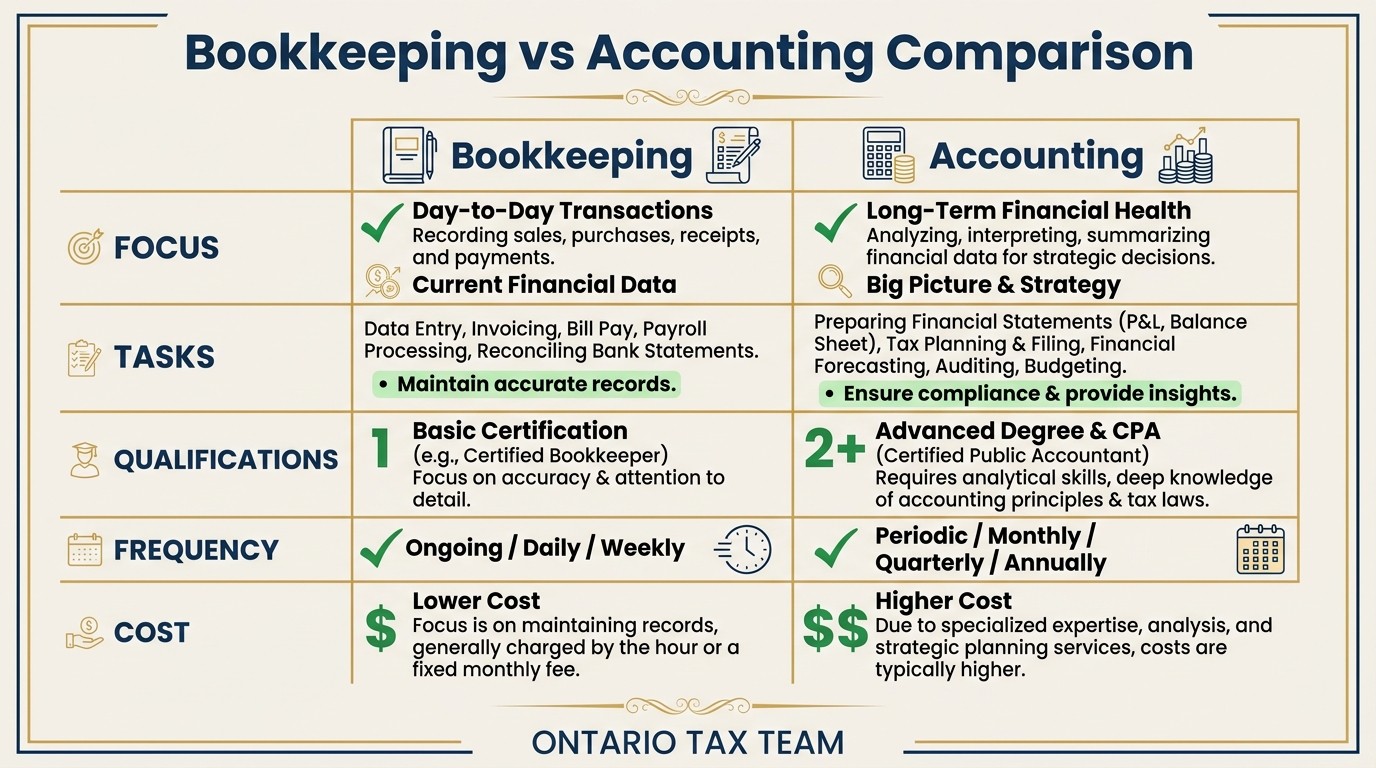
The simplest way to think about it: bookkeeping records what happened, and accounting explains what it means. Bookkeeping is transactional and detail-oriented. Accounting is analytical and strategic.
Bookkeepers typically work with your books on a daily, weekly, or monthly basis to keep everything current. Accountants step in periodically - often quarterly or at year-end - to review the big picture, prepare tax filings, and provide financial advice.
Do You Need a Bookkeeper, an Accountant, or Both?
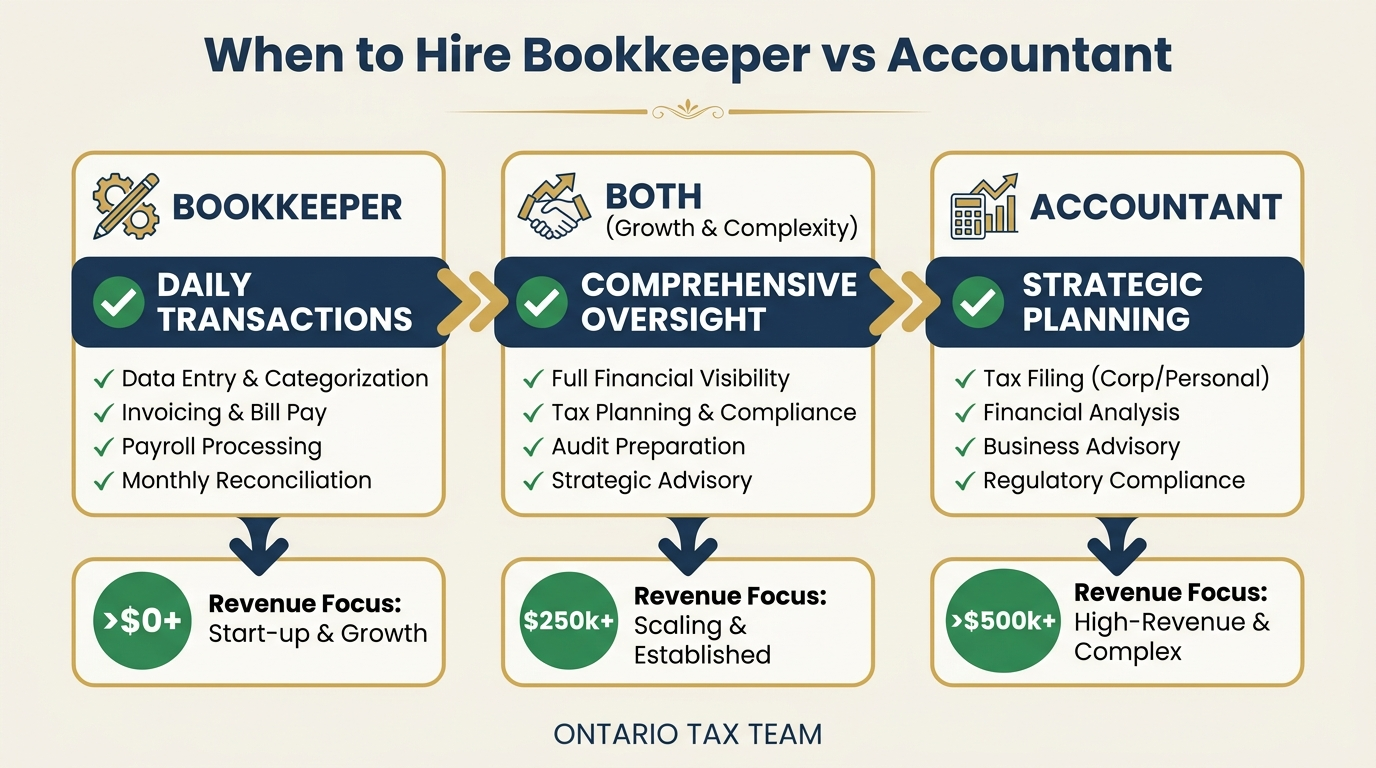
Most small businesses in Ontario need both. A bookkeeper keeps your day-to-day records clean and organized. An accountant uses those records to prepare your taxes, provide financial insights, and help you plan for the future.
Some firms - like Ontario Tax Team - offer both bookkeeping and accountingunder one roof. This eliminates the communication gaps that occur when your bookkeeper and accountant are separate providers who don't coordinate with each other.
When You Definitely Need a Bookkeeper
- You have more than a handful of transactions per month
- You're falling behind on expense tracking
- Your bank reconciliations are months behind - see our guide on catching up on overdue bookkeeping
- You're spending evenings and weekends on data entry
When You Definitely Need an Accountant
- Tax season is approaching and you need returns filed
- You're considering incorporating your business
- You've received a CRA notice or audit request
- You need financial statements for a bank loan or investor
- You want to minimize your tax bill through strategic tax planning
The Cost Factor
Bookkeeping services in Canada typically range from $300 to $800 per month for small businesses, depending on transaction volume and complexity. Accounting services - including tax preparation and advisory - are usually charged separately, either as fixed fees or hourly rates. For a detailed breakdown, see our guide on how much a bookkeeper costs in Canada.
Hiring a firm that handles both can often be more cost-effective than paying for each service separately, since the bookkeeper and accountant work within the same system.
Bottom Line
Bookkeeping and accounting are complementary services that every business needs. Bookkeeping keeps your financial records accurate and current. Accounting transforms those records into insights, tax savings, and strategic guidance. Together, they give you a complete picture of your business's financial health.
Whether you need bookkeeping services, professional accounting, or tax preparation, Ontario Tax Team delivers it all under one roof from our Oakville office.
Key Takeaways
- •Bookkeeping records transactions; accounting analyzes and interprets them
- •Most small businesses need both a bookkeeper and an accountant
- •Using one firm for both services improves coordination and can reduce costs
- •Clean bookkeeping is the foundation for accurate tax filing and financial planning
Need Help With Bookkeeping or Accounting?
Our team provides professional bookkeeping and accounting services for Ontario businesses under one roof. Book a free 15-minute consultation.