Every Canadian corporation - whether it earned revenue or sat dormant for the entire year - must file a T2 Corporation Income Tax Return with the CRA. It's the corporate equivalent of your personal T1, but considerably more complex. If you've been staring at the T2 form wondering where to even start, this guide breaks the process into manageable steps so you understand what's involved, even if you ultimately decide to hand it off to a professional.
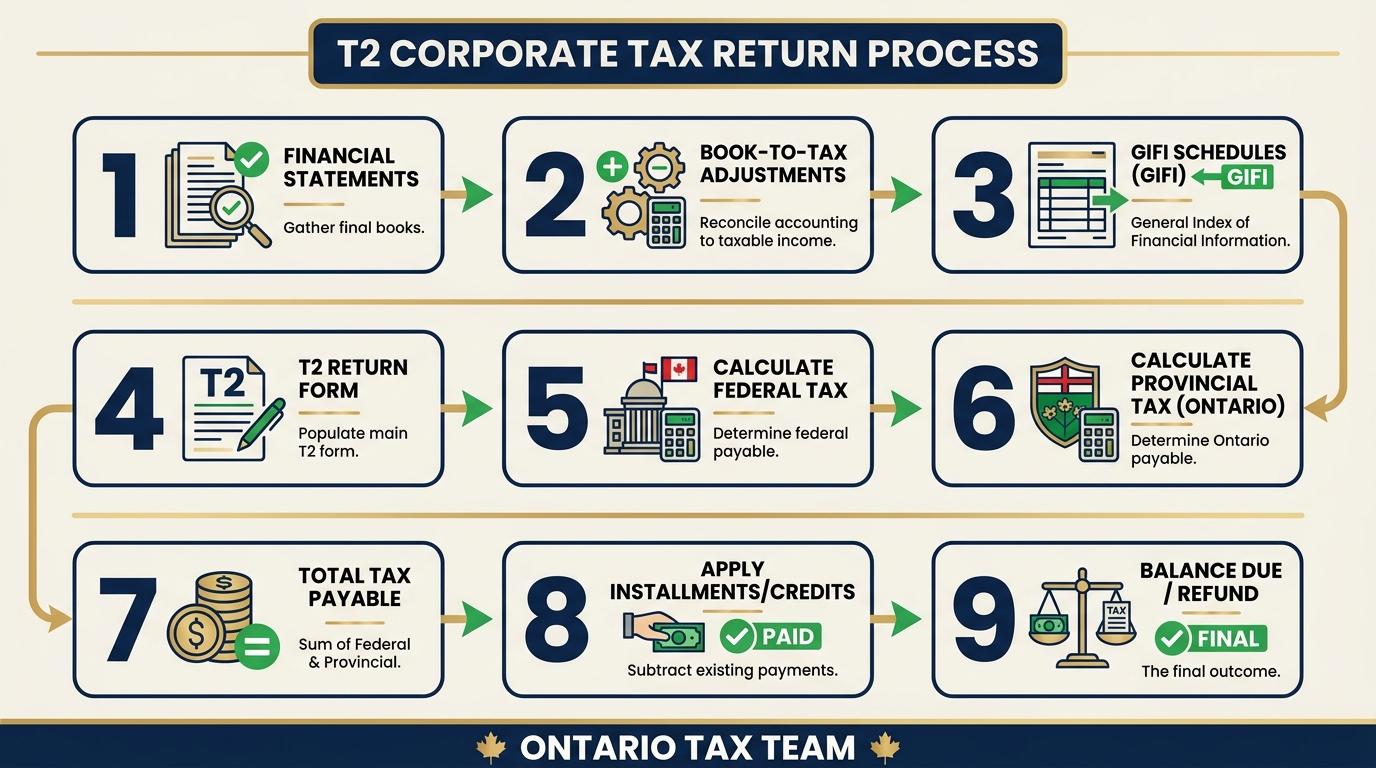
Step 1: Prepare Your Financial Statements
Before you touch the T2 itself, you need a complete set of financial statements for the fiscal year: an income statement (profit and loss), a balance sheet, and a statement of retained earnings. These don't need to be audited for most small corporations, but they need to be accurate and complete. Your financial statement preparation is the foundation everything else builds on.
The financial statements must follow Canadian accounting standards - either ASPE (Accounting Standards for Private Enterprises) or IFRS, depending on your situation. Most small Canadian-controlled private corporations use ASPE. The numbers from these statements feed directly into the GIFI schedules that make up the bulk of the T2 return.
Step 2: Complete the GIFI Schedules
The General Index of Financial Information (GIFI) is the CRA's standardized coding system that maps your financial statement line items to specific codes. The three core GIFI schedules you'll complete are:
- Schedule 100 (S100) - Balance Sheet: Every asset, liability, and equity item from your balance sheet gets a GIFI code. Cash is code 1000, accounts receivable is 1060, inventory is 1120, and so on. The total assets must equal total liabilities plus equity, just like your balance sheet.
- Schedule 125 (S125) - Income Statement: Revenue, cost of goods sold, and every expense category gets mapped here. Revenue from sales is code 8000, subcontracts are 8110, advertising is 8520, insurance is 8690. Each line from your income statement has a corresponding GIFI code.
- Schedule 200 (S200) - Return Identification: This captures your corporation's basic information - name, BN, fiscal year dates, type of corporation, province, and whether this is a first return, an amended return, or a final return.
Getting the GIFI codes right matters. If the CRA's automated systems flag a mismatch between your GIFI numbers and your reported taxable income, you could trigger a review.
Step 3: Calculate Taxable Income (Schedule 1)
Schedule 1 reconciles your accounting net income (from Schedule 125) to your taxable income for tax purposes. These are rarely the same number because accounting rules and tax rules differ. Common adjustments include:
- Add back: Amortization (since CCA replaces it for tax), meals and entertainment (50% non-deductible), penalties and fines, life insurance premiums, and non-deductible reserves
- Deduct: Capital cost allowance (CCA), the non-taxable portion of capital gains, and any amounts already taxed in prior years
The result is your net income for tax purposes - the number that actually gets taxed. Understanding the difference between accounting income and taxable income is one of the reasons many business owners work with a corporate tax professional rather than attempting this alone.
Step 4: Calculate Capital Cost Allowance (Schedule 8)
Schedule 8 is where you claim CCA - the tax version of depreciation. Each depreciable asset belongs to a CCA class with a prescribed rate. Common classes include:
- Class 1 (4%): Buildings acquired after 1987
- Class 8 (20%): Furniture, fixtures, and most equipment
- Class 10 (30%): Vehicles, general-purpose electronic equipment
- Class 10.1 (30%): Passenger vehicles costing more than $37,000
- Class 12 (100%): Small tools, computer software, china, cutlery
- Class 50 (55%): Computer hardware acquired after March 18, 2007
For each class, you start with the undepreciated capital cost (UCC) from last year, add new acquisitions, subtract dispositions, apply the half-year rule (or the Accelerated Investment Incentive), and multiply by the class rate. The total CCA claimed flows back to Schedule 1 as a deduction from taxable income.
Step 5: Calculate Federal Tax (Schedule 500)
Schedule 500 calculates your Part I federal tax. The base federal rate is 38% of taxable income, but after the federal abatement (10% for provincial allocation) and various reductions, the effective rate for most small CCPCs is much lower. General rate reduction brings the federal rate down to 15% for income not eligible for the small business deduction, and the SBD brings it down further for qualifying active business income.
Step 6: Claim the Small Business Deduction (Schedule 507)
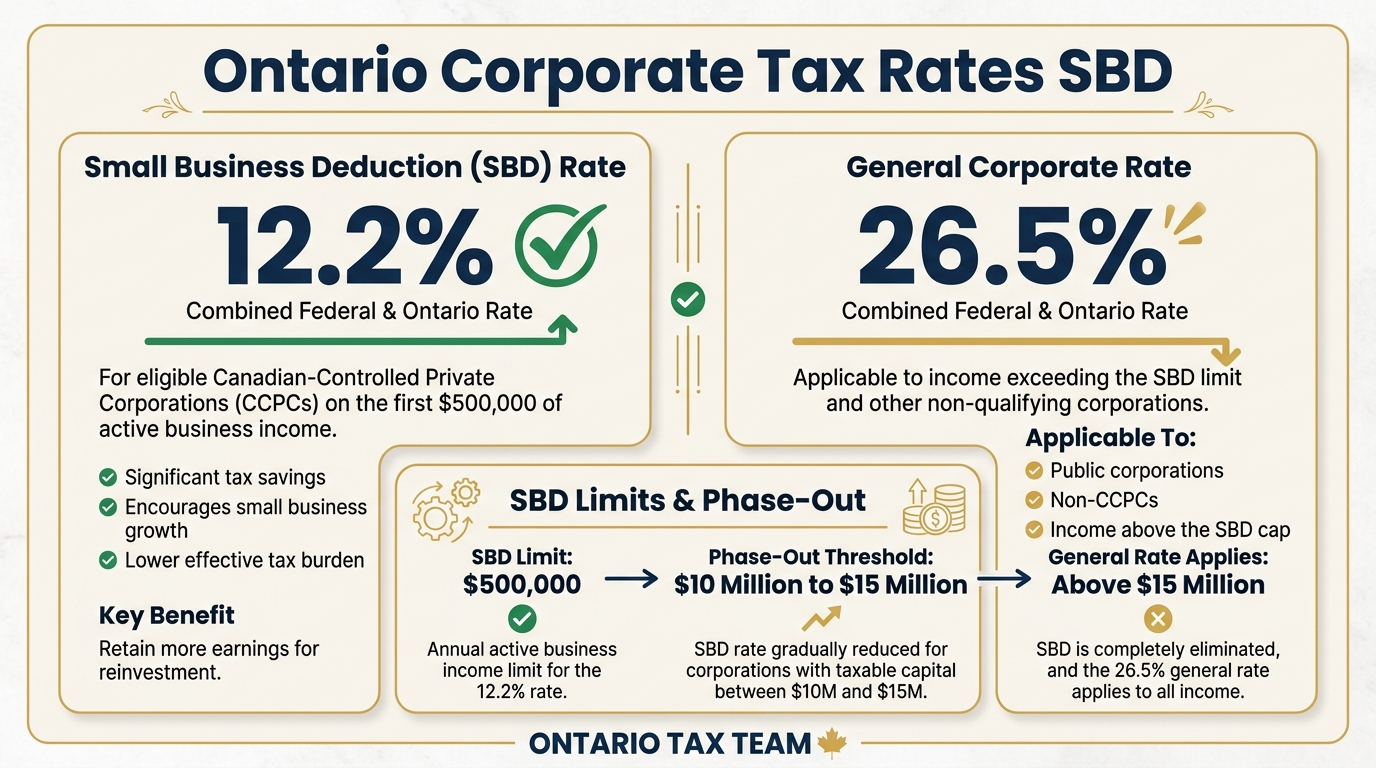
If your corporation is a Canadian-controlled private corporation, Schedule 507 calculates the small business deduction. The SBD reduces the federal tax rate on the first $500,000 of active business income from 15% down to 9%. Combined with Ontario's small business rate of 3.2%, the total tax on qualifying income is just 12.2%.
The $500,000 limit must be shared among associated corporations. If your business is connected to other companies through common ownership, the business limit gets allocated across all of them. The SBD also starts clawing back once taxable capital exceeds $10 million and is fully eliminated at $15 million. For a deeper dive, see our guide on the differences between T1 and T2 returns.
Source: Canada Revenue Agency, Ontario Ministry of Finance
Step 7: Calculate Provincial Tax (Schedule 510)
Schedule 510 handles Ontario's corporate income tax. Ontario's general corporate rate is 11.5%, and the small business rate is 3.2%. The provincial tax calculation largely mirrors the federal structure but uses Ontario-specific rates and thresholds. If your corporation operates in multiple provinces, you'll need to allocate taxable income between them based on revenue and payroll in each jurisdiction.
Step 8: Report Dividends Paid (Schedule 3)
If your corporation paid dividendsduring the fiscal year, Schedule 3 reports them. You'll need to classify dividends as either eligible or non-eligible (ineligible), which determines the tax treatment for the recipient shareholders. Non-eligible dividends are typical for small CCPCs that claimed the SBD, while eligible dividends come from income taxed at the general corporate rate.
Make sure the dividend amounts on Schedule 3 match the T5 slips you issue to shareholders and the resolutions in your minute book. Inconsistencies here are a common audit trigger.
Step 9: Determine the Balance Due
After calculating federal and provincial tax, subtract any instalments already paid during the year and any tax credits (SR&ED, investment tax credits, etc.). The result is your balance due - or your refund. Remember, the balance is due two months after year-end for most small CCPCs (three months if certain conditions are met), even though the return itself isn't due for six months.
Late payment triggers interest charges that compound daily at the CRA's prescribed rate. Late filing adds a penalty of 5% of the balance due plus 1% per month for up to 12 months. For repeat late filers, the penalties double. See our guide to Canadian tax deadlines for all filing dates.
Filing Methods
Since 2024, most corporations are required to file their T2 returns electronically using CRA-certified software. Paper filing is only available to insurance corporations and non-resident corporations in limited circumstances. Your accountant will use professional tax software that generates all the schedules, validates the data, and transmits the return via EFILE or the CRA's Internet Filing service.
Popular T2 software options include Profile (by Intuit), TaxCycle, DT Max, and Cantax. If you're determined to file yourself, TaxCycle offers a pay-per-return option. But given the complexity involved, most business owners find that working with a professional on our corporate tax team saves them more in avoided errors and missed deductions than the cost of the service.
Common T2 Filing Errors to Avoid
- Wrong fiscal year-end: Make sure the dates on the return match your articles of incorporation or the year-end on file with the CRA
- Misclassifying dividends: Eligible vs. non-eligible matters for shareholder tax treatment and affects the GRIP/LRIP balances
- Forgetting to file a nil return: Even if your corporation had no activity, the T2 is still due and penalties still apply
- Incorrect associated corporation allocations: If you have related companies, the $500,000 SBD limit and the $1.5 million immediate expensing limit must be shared
- Missing the payment deadline: Filing on time but paying late still triggers interest charges from the two- or three-month mark
When to Hire a CPA
If your corporation is straightforward - a single shareholder, a few expense categories, no employees, no complex transactions - and you're comfortable with tax software, filing your own T2 is technically possible. Our guide on choosing the right accountant can help you decide. But for most corporations, the interplay between Schedules 1, 8, 500, 507, and 510, plus the GIFI mapping, shareholder loan rules, and dividend classification, makes professional help well worth the investment.
A CPA doesn't just fill in forms. They review your corporate structure, identify deductions you might miss, ensure compliance with CRA requirements, and help you plan for the year ahead. Our corporate tax filing guide covers what to expect when you work with a professional.
Key Takeaways
- •Every Canadian corporation must file a T2 return, even if it had zero revenue or activity during the year
- •Accurate financial statements are the foundation - the entire T2 builds on your income statement and balance sheet
- •Schedule 1 reconciles accounting income to taxable income by adding back non-deductible items and deducting CCA
- •The small business deduction reduces the combined federal-Ontario rate to 12.2% on the first $500,000 of active business income
- •Taxes owed are due two to three months after year-end, while the return itself is due at six months - late payment triggers daily compounding interest
Need Help Filing Your T2 Return?
Our corporate tax team handles every step of the T2 filing process, from financial statements to CRA submission. Book a free 15-minute consultation.