
Running payroll is one of the most important responsibilities any Canadian employer takes on. Every time you pay an employee, you're required to calculate and withhold three mandatory deductions - Canada Pension Plan (CPP) contributions, Employment Insurance (EI) premiums, and federal and provincial income tax - and then remit those amounts to CRA on a strict schedule.
Getting payroll wrong can be costly. CRA imposes penalties and interest for late or incorrect remittances, and employees depend on accurate deductions for their own tax filings. This guide explains how each deduction works, what employers owe on top of employee deductions, and how to stay compliant.
The Three Mandatory Payroll Deductions
Every employee's paycheque in Canada is subject to three categories of deductions. As an employer, you calculate these amounts, withhold them from the employee's gross pay, add your employer portion where applicable, and remit everything to CRA.
1. Canada Pension Plan (CPP)
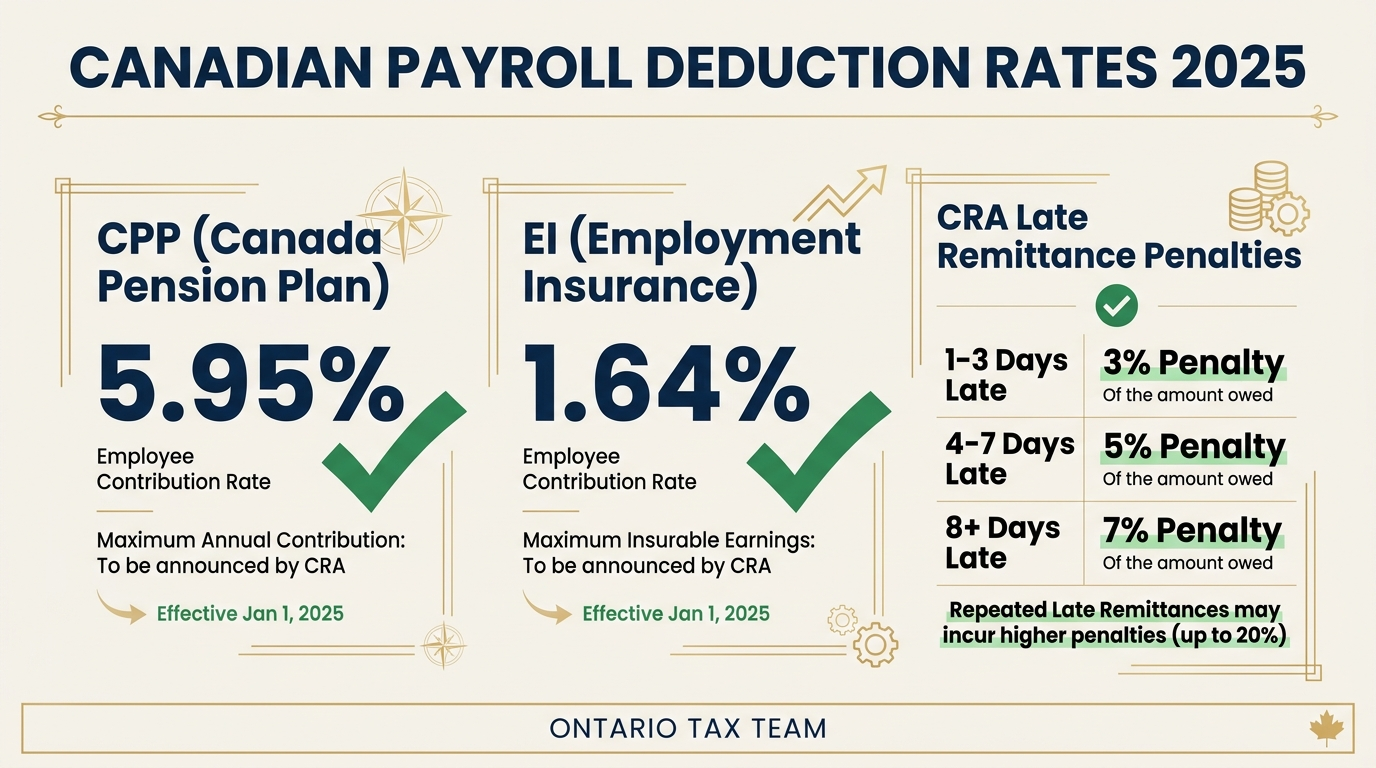
CPP is a contributory retirement pension program. Both the employee and employer contribute equally. For 2025, the employee contribution rate is 5.95% on pensionable earnings between the basic exemption of $3,500 and the first earnings ceiling of approximately $71,300 (known as the Year's Maximum Pensionable Earnings, or YMPE).
The employer matches the employee's CPP contribution dollar for dollar. So if an employee contributes $4,034 in CPP for the year, the employer also pays $4,034. Self-employed individuals pay both the employee and employer portions.
CPP2: The Second Earnings Ceiling
Starting in 2024, a second CPP contribution tier (CPP2) applies to earnings between the first and second earnings ceilings. For 2025, the second ceiling is approximately $79,400. The CPP2 rate is 4% for both employees and employers on earnings between the first and second ceiling. This additional contribution provides enhanced retirement benefits.
CPP2 means that higher-earning employees now have additional deductions beyond the traditional CPP maximum, and employers have a corresponding additional cost.
2. Employment Insurance (EI)
EI provides temporary income support for workers who lose their jobs, are on parental leave, or are unable to work due to illness. The employee premium rate for 2025 is 1.64% on insurable earnings up to the maximum insurable amount (approximately $65,700).
Unlike CPP where contributions are matched 1:1, the employer EI contribution is 1.4 times the employee's premium. So for every $1.00 an employee pays in EI, the employer pays $1.40. This higher employer ratio is a significant payroll cost that many new business owners underestimate.
EI Exemptions
Some workers are exempt from EI premiums, including:
- Employees who own more than 40% of the corporation's voting shares (and their family members, in some cases)
- Certain casual employment arrangements
- Workers in specific provincial government roles with equivalent coverage
If you're a business owner who pays yourself a salary through your corporation, check whether you're exempt from EI. Many owner-operators are, which reduces both the employee and employer cost.
3. Federal and Provincial Income Tax
Income tax withholding is based on the employee's gross earnings, pay frequency, and the information they provided on their TD1 form (Personal Tax Credits Return). The TD1 captures the employee's basic personal amount and any additional credits they're entitled to (spouse, disability, tuition, etc.).
CRA publishes payroll deduction tables and an online calculator (the Payroll Deductions Online Calculator, or PDOC) that determine the correct withholding amount. Most payroll software handles this automatically, but it's critical that employee TD1 forms are up to date. If an employee's personal situation changes - marriage, divorce, additional income sources - they should submit an updated TD1.
Source: Canada Revenue Agency (2025 payroll deduction rates)
Employer vs Employee Portions
Understanding the split between employee and employer contributions is important for budgeting. Here's a summary:
- CPP: Employee pays 5.95%, employer matches at 5.95% (plus CPP2 at 4% each, if applicable)
- EI: Employee pays 1.64%, employer pays 1.4x the employee amount (approximately 2.30%)
- Income tax: Withheld entirely from the employee's pay; no additional employer cost
As a rough estimate, the employer's statutory payroll costs (CPP and EI employer portions) add approximately 7.5% to 10% on top of each employee's gross salary, depending on earnings levels.
Remittance Schedules
Once you've withheld deductions and calculated employer portions, you must remit everything to CRA according to your assigned remittance schedule. Your schedule is based on your average monthly withholding amount (AMWA):
Regular Remitter
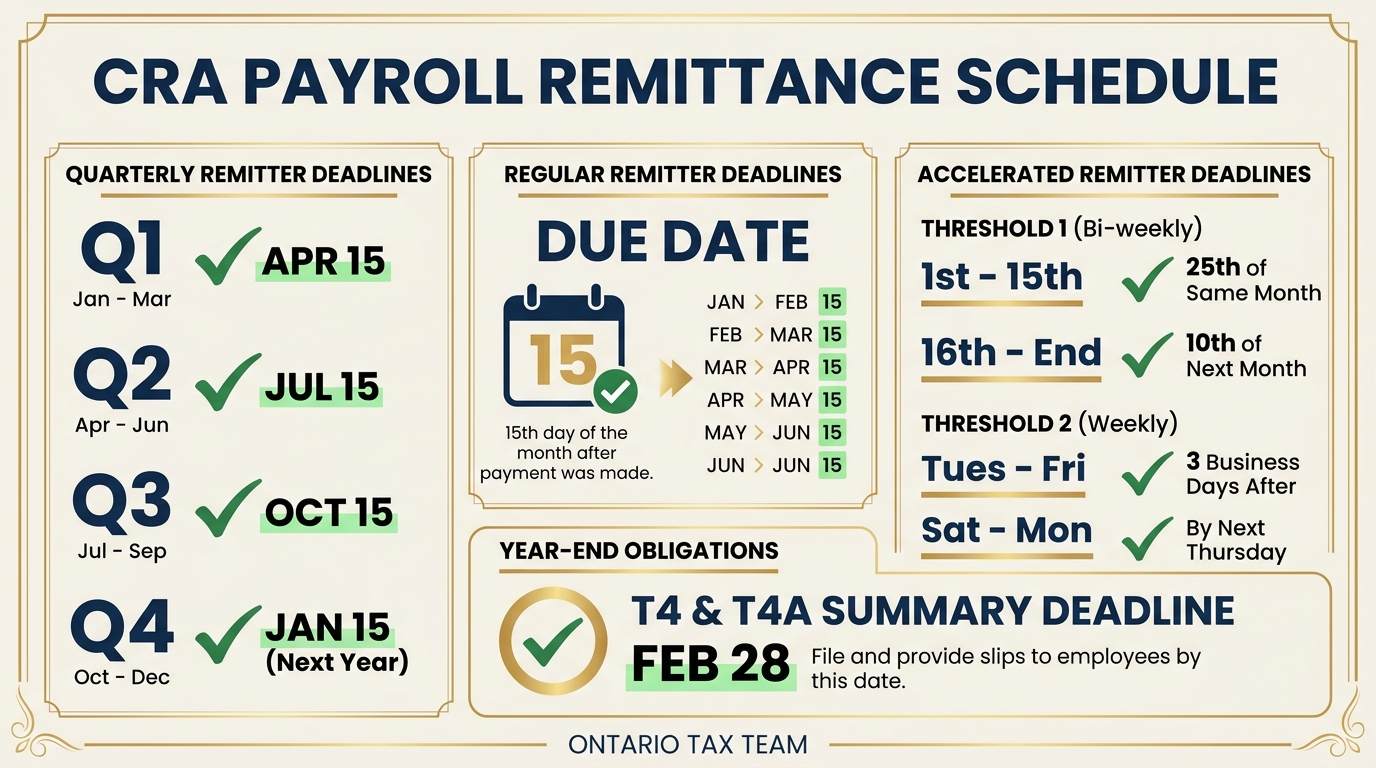
If your AMWA is less than $25,000, you're a regular remitter. Remittances are due by the 15th of the month following the month in which you paid employees. For example, January payroll deductions are due by February 15.
Quarterly Remitter
New small employers with an AMWA below $1,000 and a perfect compliance history may qualify for quarterly remittances. Payments are due by the 15th of the month following each quarter (April 15, July 15, October 15, January 15).
Accelerated Remitter
Larger employers with higher AMWAs must remit more frequently:
- Threshold 1 (AMWA $25,000-$99,999.99): Twice-monthly remittances - deductions from the first 15 days of the month are due by the 25th, and deductions from the 16th to month-end are due by the 10th of the following month
- Threshold 2 (AMWA $100,000+): Up to four remittances per month, due within three working days of certain pay periods
CRA notifies you of your remittance frequency. It's based on your prior year's withholding amounts and is reassessed annually. For more on CRA deadlines, see our guide on when taxes are due in Canada.
T4 Preparation and Filing
At the end of each calendar year, employers must prepare T4 slips for every employee summarizing their total employment income, CPP contributions, EI premiums, and income tax deducted. T4 slips must be provided to employees and filed with CRA by the last day of February.
For a detailed breakdown of what employees see on their T4, read our guide on what a T4 slip is and how to read it. Employers also file a T4 Summary that reconciles total deductions remitted during the year with the amounts reported on individual T4 slips.
Penalties for Late Remittance
CRA takes payroll remittance deadlines seriously. Penalties for late remittance are:
- 1-3 days late: 3% penalty on the amount due
- 4-5 days late: 5% penalty
- 6-7 days late: 7% penalty
- More than 7 days late: 10% penalty
- Repeat offenders: Up to 20% penalty if you've been penalized more than once in the same calendar year
On top of penalties, CRA charges daily compound interest on outstanding amounts. Directors of corporations can be held personally liable for unremitted payroll deductions - this liability pierces the corporate veil, which means your personal assets are at risk.
Payroll Software Options
Manual payroll calculations are error-prone and time-consuming. Most small businesses use payroll software or services to automate the process. Common options include:
- QuickBooks Payroll: Integrates with QuickBooks Online for seamless bookkeeping
- Wagepoint: Canadian-focused, simple interface, handles remittances and T4s
- Ceridian Dayforce: Enterprise-grade solution for larger businesses
- ADP: Full-service payroll processing with compliance support
- Rise People: Canadian HR and payroll platform for small to mid-size businesses
All reputable payroll software automatically calculates CPP, EI, and income tax based on current rates and employee TD1 information. Many also handle direct deposits, generate pay stubs, and prepare year-end T4s.
When to Outsource Payroll
Outsourcing payroll makes sense when the complexity or time commitment exceeds what you can manage in-house. Consider outsourcing if:
- You have more than a few employees and payroll takes significant time each period
- You're not confident in your ability to calculate deductions correctly - mistakes can be costly
- You want to eliminate the risk of late remittance penalties
- Your employees are in multiple provinces with different tax rates
- You need to focus your time on running the business rather than administration
Ontario Tax Team's payroll services handle everything from deduction calculations to CRA remittances to year-end T4 preparation. Our payroll team works with businesses of all sizes, and our bookkeeping service ensures payroll entries flow seamlessly into your financial records.
Bottom Line
Payroll deductions in Canada are straightforward in concept - CPP, EI, and income tax - but the details matter. Understanding how payroll works is especially important when deciding between salary and dividendsfrom your corporation. Rates change annually, employer contributions add significantly to your costs, and CRA's remittance deadlines carry real penalties for non-compliance. Whether you handle payroll yourself with software or outsource it entirely, accuracy and timeliness are non-negotiable. Getting payroll right protects your employees, your business, and you personally as a director.
Key Takeaways
- •Three mandatory deductions: CPP, EI, and income tax - employers match CPP and pay 1.4x the employee EI amount
- •CPP2 (introduced in 2024) adds a second earnings ceiling with a 4% contribution rate for both employees and employers
- •Remittance schedules range from quarterly to four times monthly, based on your average monthly withholdings
- •Late remittance penalties start at 3% and can reach 20% for repeat offenders - directors are personally liable
- •Outsourcing payroll eliminates compliance risk and frees up time for running your business
Need Help With Payroll?
Our payroll team handles deduction calculations, CRA remittances, and year-end T4 preparation for businesses of all sizes. Book a free 15-minute consultation.