Every year, thousands of Canadians make avoidable mistakes on their tax returns that cost them money - either through penalties and interest from the CRA, or by leaving legitimate deductions and credits on the table. Some mistakes are simple oversights; others stem from misunderstanding how the tax system works.
Here are the most common tax filing mistakes we see, along with practical advice on how to avoid each one.
1. Missing the Filing Deadline
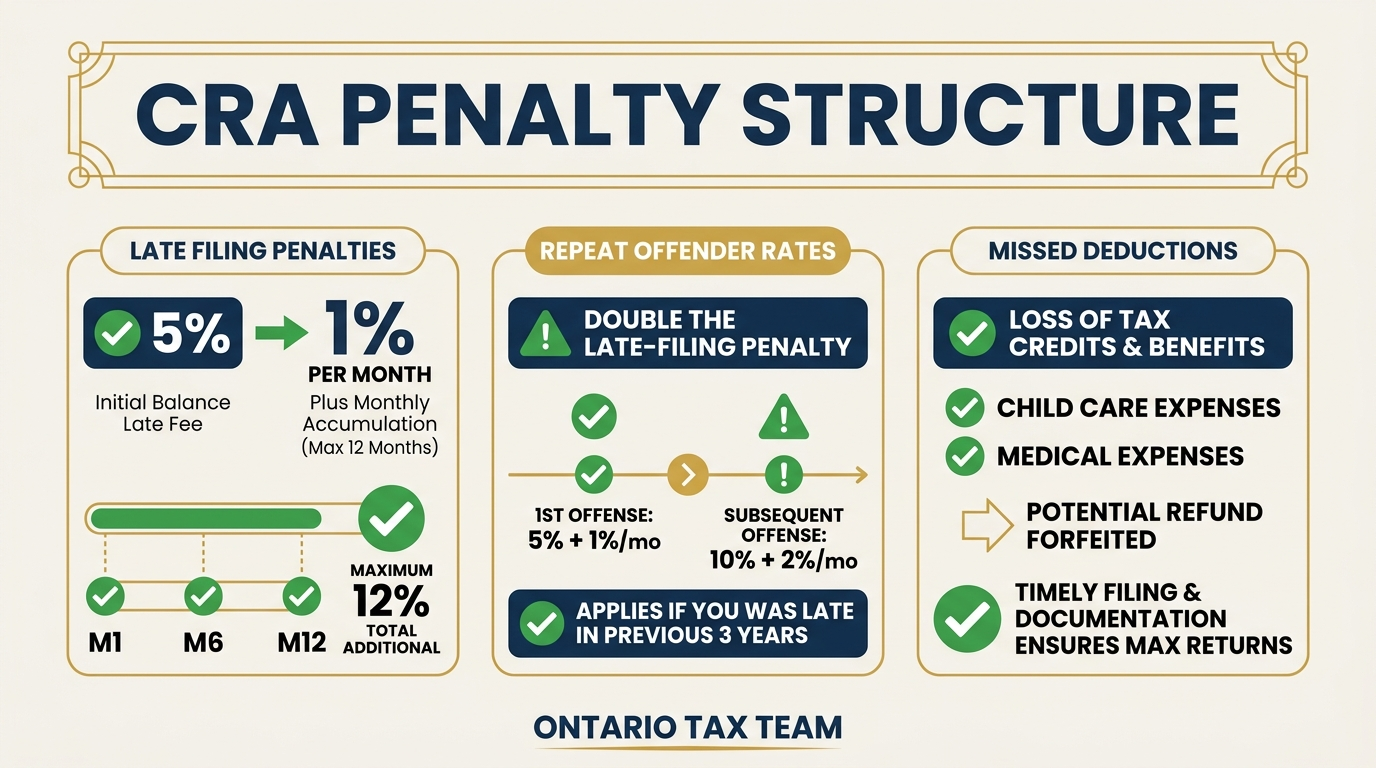
The personal tax filing deadline in Canada is April 30 for most individuals, and June 15 for self-employed taxpayers (though any balance owing is still due April 30). Missing these dates triggers an automatic late-filing penalty of 5% of the balance owing, plus 1% per additional month, up to 12 months. For repeat offenders, the penalty doubles.
The fix is straightforward: mark your calendar well in advance. Even if you can't pay the full amount owed, always file on time to avoid the penalty. You can set up a payment arrangement with the CRA after filing. Check our complete guide to Canadian tax deadlines for every important date.
Source: Canada Revenue Agency
2. Not Reporting All Sources of Income
The CRA receives copies of your T4s, T5s, T3s, and other information slips from your employers, banks, and investment firms. If the income on your return doesn't match what they have on file, you'll receive a reassessment notice - and potentially penalties for repeated omissions.
Common sources of missed income include:
- Freelance or gig economy earnings (Uber, Airbnb, consulting)
- Interest from savings accounts and GICs
- Dividends from investments
- Foreign employment or investment income
- Severance or termination pay
- Tips and gratuities
Before filing, log into your CRA My Account to view all information slips the CRA has on file. Cross-reference these against your own records to make sure nothing is missing. See our guide on preparing your documents for tax season for a complete checklist.
3. Forgetting to Claim Eligible Deductions
This is the opposite problem - and it costs you just as much. Many Canadians miss out on deductions they're legally entitled to claim. Common overlooked deductions include:
- Moving expenses: If you moved at least 40 km closer to a new job or school, you can deduct moving costs
- Union and professional dues: These are deductible on line 21200
- Carrying charges: Investment management fees and interest on money borrowed to invest
- Child care expenses: Claimed by the lower-income spouse
- Home office expenses: Available for employees who work from home, not just the self-employed
A professional tax preparation service will review your full financial picture to ensure every eligible deduction is claimed. For more ideas, read our guide to reducing your personal taxes in Ontario.
4. Math Errors and Transposition Mistakes
It sounds basic, but math errors remain one of the most common reasons the CRA adjusts returns. Transposing numbers, adding incorrectly, or entering amounts on the wrong line can all trigger a reassessment. E-filing with certified tax software eliminates most math errors automatically, which is one of the best arguments for electronic filing.
5. Wrong SIN or Incorrect Personal Information
An incorrect Social Insurance Number, a misspelled name, or an outdated address can cause processing delays, misdirected correspondence, and even lost refunds. Double-check your SIN on every return. If you've moved, update your address with the CRA through My Account or by letter before filing.
6. Not Filing Because You Can't Pay
This is one of the costliest mistakes people make. Many taxpayers avoid filing their return entirely because they know they owe money and can't pay. But not filing triggers the late-filing penalty on top of the interest you'll already owe. The CRA charges compound daily interest on unpaid balances regardless of whether you file, so the penalty is purely additional cost.
Always file on time, even if you can't pay. Once your return is assessed, you can call the CRA to negotiate a payment plan or apply for taxpayer relief if you're experiencing financial hardship.
7. Not Carrying Forward Unused Amounts
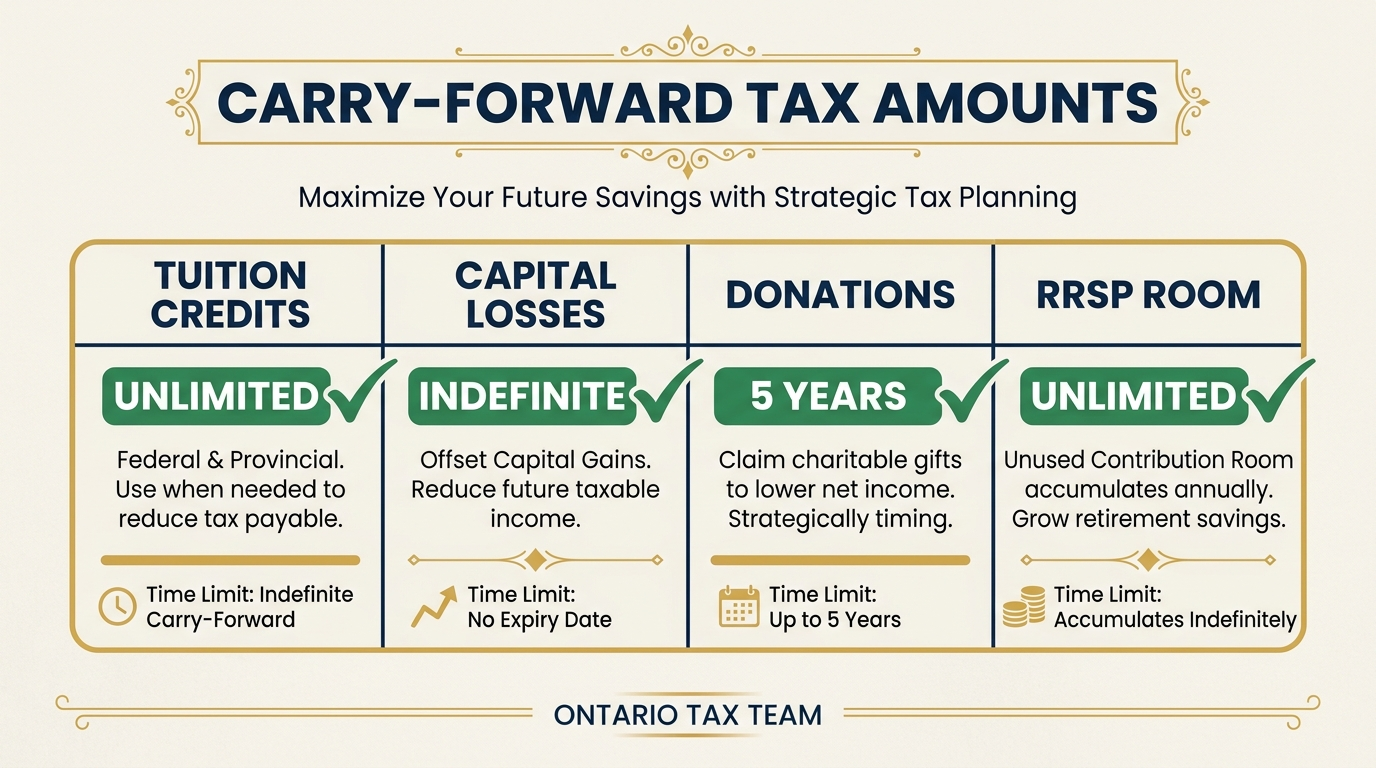
Several tax credits and deductions can be carried forward if you can't use them in the current year. These include:
- Tuition credits: Unused tuition amounts carry forward indefinitely
- Capital losses: Net capital losses can be carried back 3 years or forward indefinitely
- Non-capital losses: Business losses carry forward up to 20 years
- Charitable donations: Unused donations carry forward up to 5 years
- RRSP contribution room: Unused room accumulates and never expires
If you're not tracking these carry-forward amounts, you could be paying more tax than necessary for years to come.
8. Missing RRSP Receipts
RRSP contributions made in the first 60 days of the year can be claimed on the prior year's return. Many taxpayers either forget to claim contributions made in January and February, or lose track of receipts for contributions made throughout the year. Your financial institution issues RRSP receipts for two periods - March to December and January to the deadline - so make sure you have both before filing.
9. Not Claiming Medical Expenses
The medical expense tax credit is one of the most underutilized credits on the Canadian tax return. Eligible expenses extend well beyond prescription drugs and doctor visits. Dental work, glasses, laser eye surgery, orthodontics, mental health therapy, travel costs for medical treatment, and many other expenses qualify. You can claim any 12-month period ending in the tax year, which gives you flexibility to pick the period with the highest expenses.
Keep every medical receipt throughout the year. Even if individual expenses seem small, they add up - and anything above the threshold (roughly 3% of your net income) generates a tax credit.
10. Filing on Paper Instead of E-Filing
Paper returns take 8 to 12 weeks for the CRA to process, compared to about two weeks for e-filed returns. Paper returns are also far more prone to processing errors, lost in transit, or delayed at the CRA. E-filing through NETFILE is faster, more secure, and reduces the chance of transcription errors. In 2026, there's really no reason to file on paper unless you're in a situation where the CRA specifically requires it.
Professional accounting firms e-file all client returns through certified software, which also generates an immediate confirmation that the CRA received your return.
Bottom Line
Most tax filing mistakes are avoidable with a little preparation and attention to detail. File on time, report all income, claim every deduction you're entitled to, and e-file to reduce errors. If your tax situation is at all complex - self-employment income, rental properties, investments, or a business - working with a professional is the best way to ensure nothing falls through the cracks. Our bookkeeping services keep your records organized year-round so filing season is stress-free.
Key Takeaways
- •Always file on time, even if you can't pay - the late-filing penalty is avoidable and expensive
- •Check CRA My Account to ensure all income slips are accounted for before filing
- •Track carry-forward amounts like tuition credits, capital losses, and unused RRSP room
- •E-file to get faster refunds and reduce the chance of errors and processing delays
Need Help Filing Your Taxes Correctly?
Our tax preparation team ensures every deduction is claimed and every mistake is avoided. Book a free 15-minute consultation.