Tax season doesn't have to be stressful. The reason it feels overwhelming for most Canadians is that they're scrambling to find documents at the last minute, digging through shoeboxes and email inboxes with the filing deadline looming. The fix is simple: get organized ahead of time.
Whether you're filing on your own or working with a professional tax preparer, having everything ready before you start makes the entire process faster, cheaper, and less likely to result in errors.
Employment Income Documents
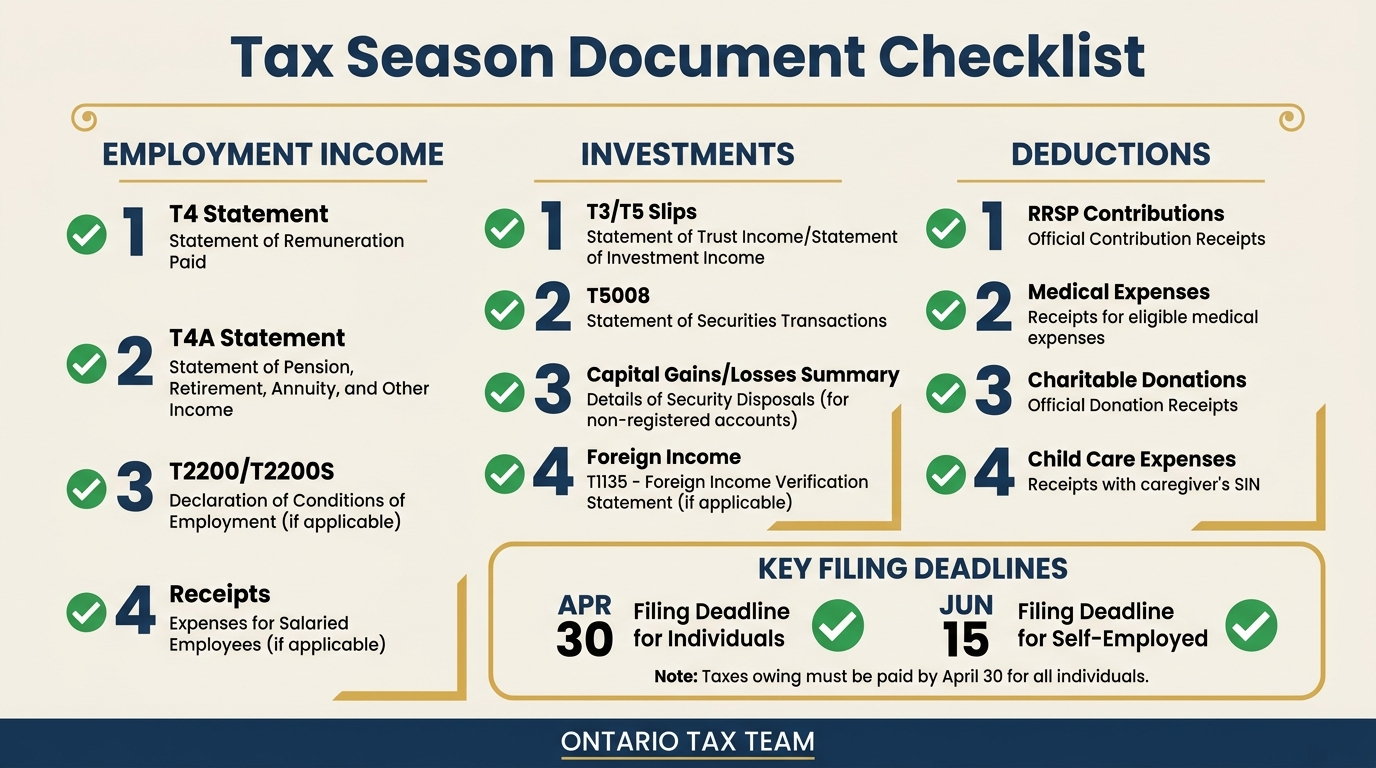
If you're employed, your employer is required to issue your tax slips by the end of February. These are the foundation of your return:
- T4 - Statement of Remuneration Paid. This is your main employment income slip. It shows your gross income, taxes deducted, CPP and EI contributions, and any taxable benefits. If you had multiple jobs during the year, you'll receive a T4 from each employer.
- T4A - Statement of Pension, Retirement, Annuity, and Other Income. This covers income like freelance payments, scholarships, research grants, and certain pension income. If you did contract work for a company and they paid you more than $500, they may have issued a T4A.
- T4E - Statement of Employment Insurance. If you received EI benefits during the year, you'll get a T4E. This income is taxable and must be reported.
Investment and Savings Documents
Investment income is reported on several different slips depending on the type of income earned:
- T5 - Statement of Investment Income. Issued by banks and financial institutions for interest, dividends, and certain foreign income earned outside registered accounts.
- T3 - Statement of Trust Income. If you hold mutual funds or investments in a trust, you'll receive a T3 showing distributions of income, capital gains, and dividends.
- T5008 - Statement of Securities Transactions. This reports the proceeds from selling investments. You'll need this plus your original purchase records to calculate capital gains or losses.
- RRSP contribution receipts. Your financial institution issues receipts for RRSP contributions. You need these to claim the deduction on your return.
Self-Employment and Rental Income Records
If you're self-employed or earn rental income, you won't receive tax slips - you're responsible for tracking everything yourself. Gather the following:
- Total revenue for the year (invoices, sales records, bank deposits)
- All business expense receipts, organized by category (advertising, supplies, travel, etc.)
- Vehicle logbook showing business versus personal kilometres
- Home office expense records (rent, utilities, insurance, property tax, internet)
- Rental income received and all related expenses (repairs, property management, insurance, mortgage interest)
Keeping your records organized throughout the year is far easier than reconstructing everything in April. Good bookkeepingmakes this automatic. If you're behind, bring everything you have to your accountant - they can work with what you've got.
Deduction and Credit Receipts
These are the documents that reduce your tax bill. Missing even one of them means paying more tax than you need to:
Medical Expenses
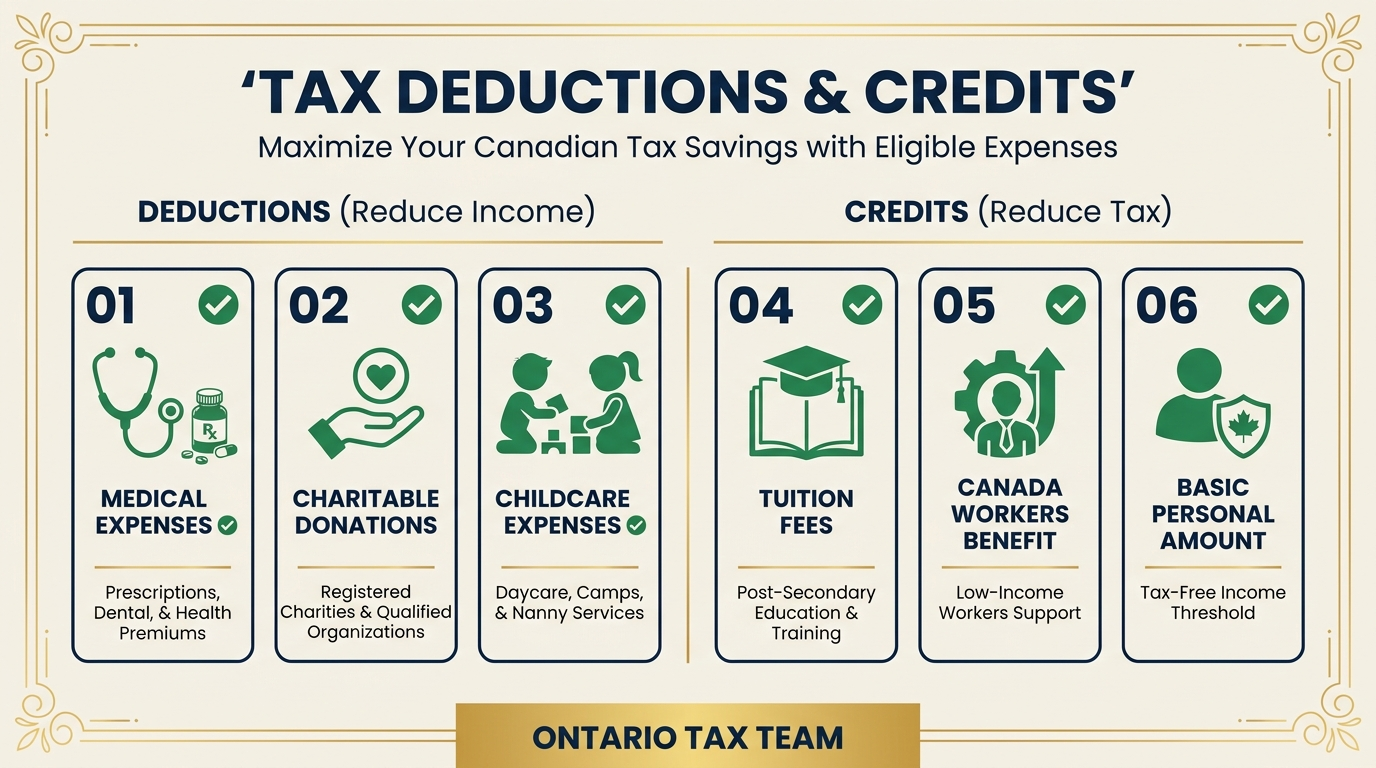
Collect receipts for medical expenses not covered by insurance: prescriptions, dental work, vision care, physiotherapy, medical travel, and private health insurance premiums. You can claim expenses for yourself, your spouse, and your dependent children. The claim covers any 12-month period ending in the tax year.
Charitable Donations
Keep official donation receipts from registered charities. The federal credit is 15% on the first $200 and 29% on amounts above $200, plus Ontario provincial credits on top. Spouses can combine donations on one return to maximize the credit.
Childcare Expenses
Daycare, before/after school care, summer camp, and nanny expenses are deductible. You'll need receipts showing the provider's name, address, and SIN or business number. The deduction is typically claimed by the lower-income spouse.
Tuition
If you or your child attended a qualifying post-secondary institution, the T2202 slip shows eligible tuition fees. Unused tuition credits can be transferred to a spouse, parent, or grandparent (up to $5,000) or carried forward to future years.
Other Important Documents
Don't overlook these items that often get missed:
- Previous year's Notice of Assessment (NOA). Your NOA from last year confirms your RRSP contribution room, any amounts carried forward, and your current account balance with CRA. You'll find it in your CRA My Account.
- CRA My Account login information. Your accountant may need access to your CRA account to verify slips, check contribution room, or file electronically. Have your credentials ready, or set up authorized representative access for your tax professional.
- T2200 - Declaration of Conditions of Employment. If you worked from home and your employer required it, you'll need this signed form to claim home office expenses using the detailed method.
- Moving expenses. If you moved at least 40 kilometres closer to a new job, school, or business location, keep receipts for moving costs including truck rental, travel, temporary lodging, and legal fees on your new home.
- Union or professional dues. These are deductible, and the amounts usually appear on your T4 slip, but keep your receipts as backup.
A Timeline for Getting Organized
Here's a practical timeline that keeps you ahead of the deadlines. For a full breakdown of key dates, see our guide on when taxes are due in Canada:
- January. Start a folder (physical or digital) for the current tax year. Gather any remaining receipts from the prior year.
- Late February. Employers and financial institutions must issue tax slips by the end of February. Watch your mail and check CRA My Account.
- Early March. RRSP contribution deadline for the previous tax year. Make last-minute contributions if you have room.
- March. Compile all slips and receipts. Book an appointment with your accountant if you're using one.
- April 30. Filing and payment deadline for most Canadians. Self-employed individuals have until June 15 to file, but any balance owing is still due April 30.
What If You're Missing a Slip?
Most tax slips are available through CRA My Account by mid-March. If a slip is missing, contact the issuer directly. If you still can't get it, you can file using the information you have and amend your return later when the slip arrives. Don't let a missing slip cause you to miss the filing deadline.
Bottom Line
Preparing your documents before tax season starts is the single most effective thing you can do to reduce stress, avoid errors, and make sure you claim every deduction you're entitled to. A complete set of documents also means your accountant can work more efficiently, which often means lower preparation fees.
If you're not sure what you need for your specific situation, our team can walk you through it. Ontario Tax Team offers comprehensive tax preparation services for individuals and families across Ontario.
Key Takeaways
- •Gather T4, T5, T3, and RRSP receipts as soon as they arrive in late February
- •Self-employed and rental income earners need to track all revenue and expenses themselves
- •Don't forget medical, charitable, childcare, and tuition receipts - these directly reduce your tax bill
- •Check CRA My Account for your previous year's NOA and any missing tax slips
- •Being organized before filing reduces stress, errors, and accountant fees
Need Help Preparing for Tax Season?
Our tax preparation team makes filing easy and ensures every deduction is captured. Book a free 15-minute consultation.