Working for yourself comes with a lot of freedom - and a lot of tax obligations that employees never have to think about. There's no employer withholding taxes from your paycheque, no T4 showing up in February with everything neatly summarized. As a self-employed person in Ontario, you're responsible for tracking your income, calculating your expenses, remitting HST (if applicable), paying both halves of CPP, and filing on time. It's a lot. But once you understand the framework, it becomes routine.
Source: Canada Revenue Agency
The T2125: Your Most Important Form
If you're a sole proprietor or in a partnership, the T2125 (Statement of Business or Professional Activities) is the core of your tax filing. This form attaches to your personal T1 returnand reports your business revenue and expenses. It's where you calculate your net business income, which then flows onto your T1 and gets taxed at your personal marginal rate.
The T2125 asks for your business name, address, industry code, and fiscal period (usually January 1 to December 31 for sole proprietors). Then it walks through your gross revenue, cost of goods sold (if applicable), and operating expenses by category. The difference between your revenue and allowable expenses is your net business income - and that's what you pay tax on. Use our tax calculator to estimate your bill based on your net income.
What Can You Deduct?
The general rule is that any expense incurred to earn business income is deductible, as long as it's reasonable. The CRA pays close attention to the “reasonable” part, so claiming a $200 dinner for a meeting with one client will raise eyebrows. Here are the major categories:
Home Office Expenses
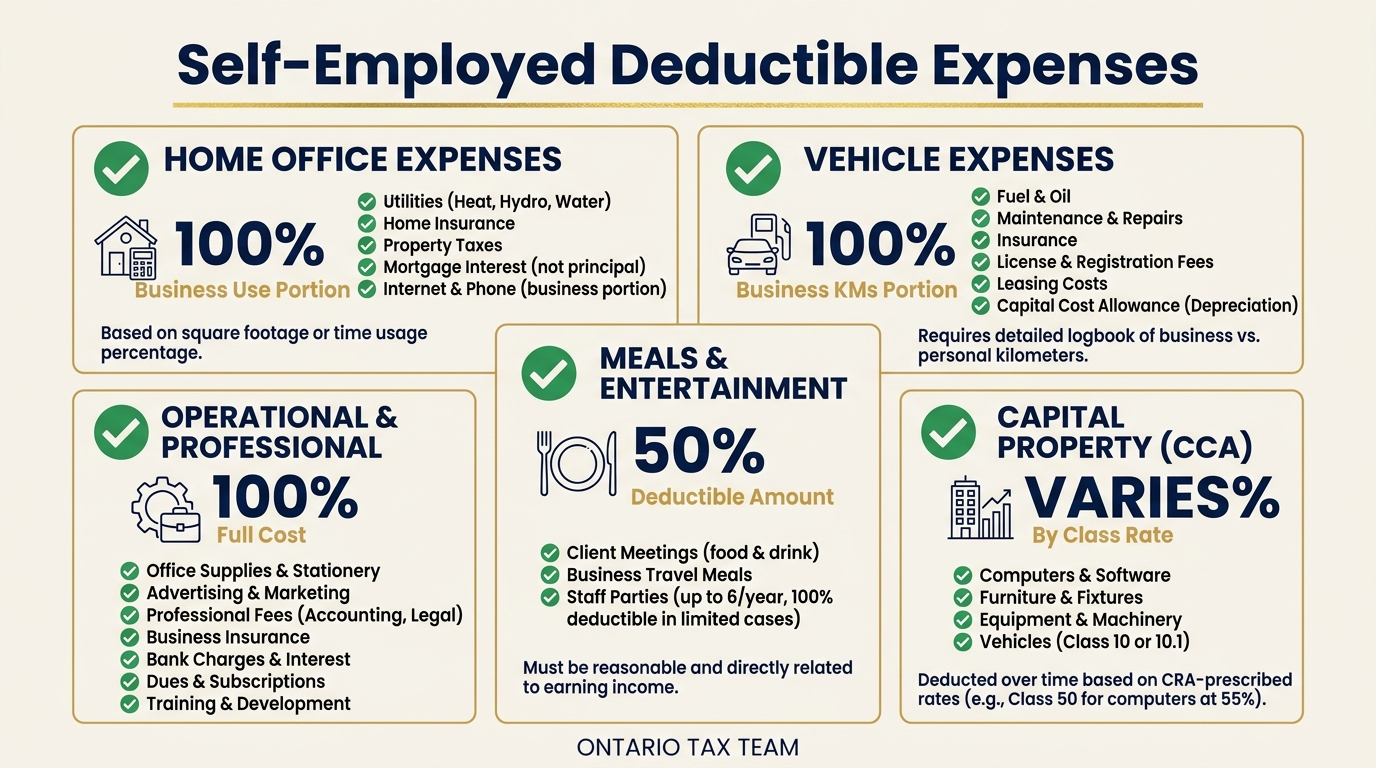
If you use part of your home regularly and exclusively for business, you can deduct a proportionate share of your rent or mortgage interest, property taxes, utilities, insurance, and maintenance. Our detailed guide on home office tax deductions walks through the full calculation. The proportion is typically based on the square footage of your workspace divided by your total home area. A 200-square-foot office in a 2,000-square-foot home means you can deduct 10% of those costs.
One important limitation: home office expenses cannot create or increase a business loss. If your business income is $5,000 and your home office costs are $6,000, you can only claim $5,000 this year. The remaining $1,000 carries forward.
Vehicle Expenses
If you use your personal vehicle for business, you can deduct the business-use portion of gas, insurance, maintenance, lease payments (up to limits), and depreciation. The CRA expects you to keep a mileage log that records the date, destination, purpose, and distance of every business trip. Without a log, your vehicle claim is extremely vulnerable in an audit.
For 2025, the CRA's prescribed rate for the deductible leasing cost is capped, and the capital cost allowance ceiling for purchased vehicles is $37,000 (plus tax). If you drive a $70,000 vehicle, you can only claim CCA on the first $37,000 of cost.
Other Common Deductions
- Advertising and marketing: Website costs, online ads, business cards, signage
- Professional fees: Accounting, legal, and consulting fees related to your business
- Office supplies: Stationery, printer ink, software subscriptions
- Meals and entertainment: 50% of meals and entertainment expenses incurred to earn business income
- Travel: Flights, hotels, and meals when travelling for business purposes
- Insurance: Business liability insurance, errors and omissions coverage
- Bad debts: Amounts owed to you that have become uncollectable
- Interest and bank charges: Interest on business loans, business bank account fees
For a more detailed breakdown, see our guide on small business tax deductions in Canada.
HST Registration: The $30,000 Threshold
If your business revenue exceeds $30,000 in any four consecutive calendar quarters (or in a single quarter), you must register for an HST account and start charging 13% HST on your taxable supplies. Once registered, you collect HST from your clients and remit it to the CRA, minus any input tax credits (ITCs) for HST you paid on business purchases.
Even if you're under $30,000, voluntary registration can make sense if your business expenses include significant HST. Registering lets you claim ITCs on those purchases, effectively getting back the HST portion. This is particularly valuable in the early stages when you're spending heavily on equipment or setup costs. Proper HST filingensures you stay compliant and capture every credit you're entitled to.
CPP Contributions: You Pay Both Halves
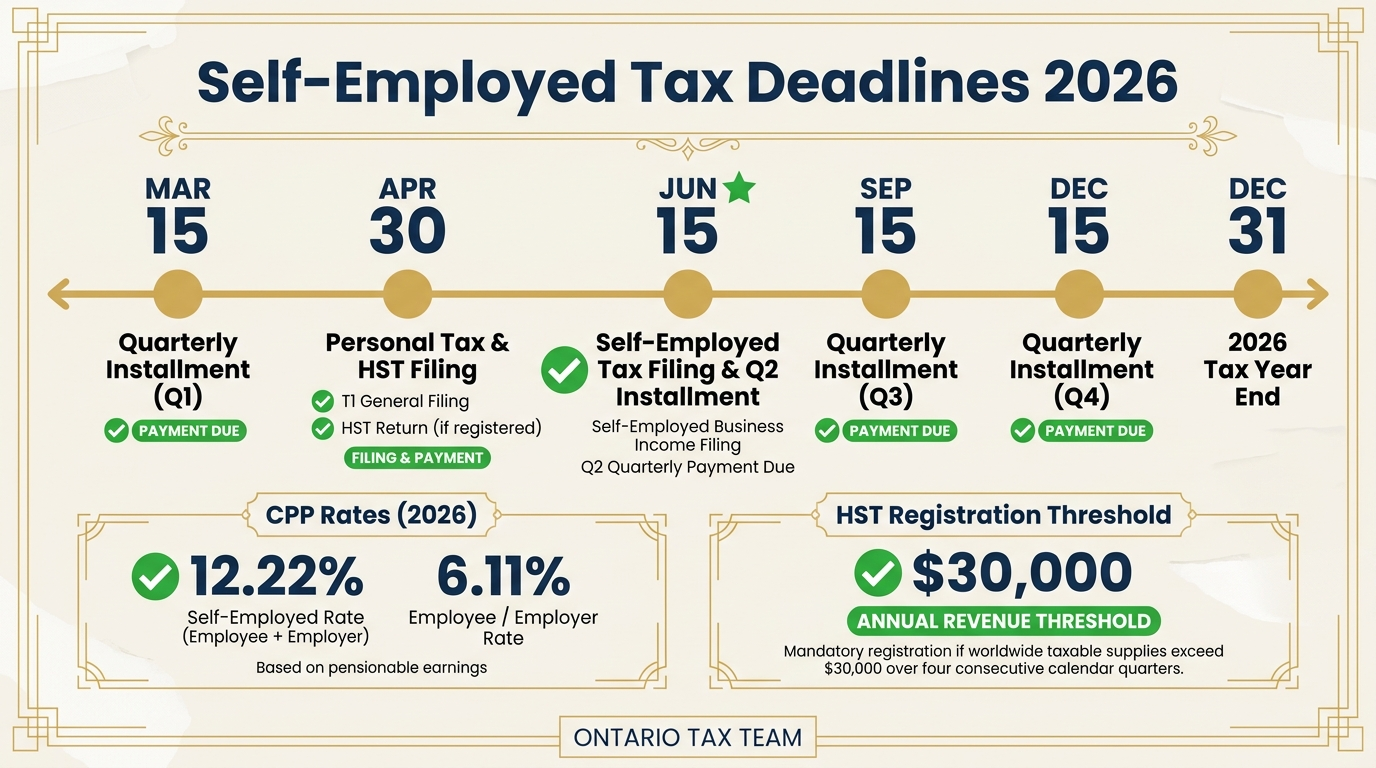
As an employee, you pay half of your Canada Pension Plan contributions and your employer pays the other half. When you're self-employed, you pay both halves. For 2025, the combined self-employed CPP contribution rate is 11.9% on earnings between $3,500 and $71,300, for a maximum contribution of about $8,068.
Starting in 2024, there's also CPP2 - a second ceiling that applies to earnings between $71,300 and $81,200 at a rate of 8%. This is a relatively new addition and catches many self-employed people off guard when they see their tax bill.
The silver lining: the employer-equivalent portion of your CPP (half of the total) is deductible on your tax return. So while you're paying double, you at least get a deduction for the portion that would normally be your employer's cost.
Filing Deadlines for Self-Employed Individuals
Self-employed individuals (and their spouses) get an extended filing deadline: June 15. However - and this trips people up every year - any balance owing is still due by April 30. The extended deadline only applies to filing the return itself, not to payment. See our complete guide to Canadian tax deadlines for all relevant dates.
If you owe $3,000 or more in taxes for the current year and owed a similar amount in the prior year, the CRA may require you to make quarterly tax installments. These are due March 15, June 15, September 15, and December 15. Missing installments triggers interest charges, so budget accordingly.
Keeping Records
The CRA requires self-employed individuals to keep all business records for at least six years from the end of the tax year they relate to. This includes invoices, receipts, bank statements, contracts, and your bookkeepingrecords. Digital records are perfectly acceptable - you don't need shoeboxes of paper receipts - but they must be organized and accessible if the CRA comes asking.
A good rule of thumb: if you spend money and want to deduct it, you need a receipt. No receipt, no deduction. Bank and credit card statements can support your claims but are generally not sufficient on their own - the CRA wants to see the actual invoice or receipt showing what was purchased and from whom.
Common Mistakes to Avoid
- Mixing personal and business finances: Open a separate business bank account. It makes bookkeeping cleaner and audits far less painful.
- Forgetting to set aside tax money: Without employer withholdings, your entire tax bill arrives at once. Set aside 25-30% of each payment you receive.
- Not tracking mileage: Reconstructing a mileage log after the fact is tedious and often inaccurate. Use an app from day one.
- Claiming personal expenses as business: Your Netflix subscription, personal cell phone plan (unless partially business), and clothing are not deductible.
- Ignoring installment requirements: The CRA charges compound daily interest on missed installments, even if you file on time.
Get Help If You Need It
Self-employed tax preparation is more complex than a standard T4-based return. Between the T2125, HST, CPP, and installment calculations, there are a lot of moving parts. Working with a professional who understands self-employed tax issuescan save you both money (through deductions you might miss) and stress (through knowing it's done right).
Key Takeaways
- •The T2125 form reports your business income and expenses as part of your personal T1 return
- •You must register for HST once revenue exceeds $30,000 in four consecutive quarters
- •Self-employed individuals pay both halves of CPP (11.9% up to $71,300, plus CPP2 on higher earnings)
- •Filing deadline is June 15, but any balance owing is due April 30
- •Keep all business records for at least six years and maintain a separate business bank account
Need Help With Self-Employed Tax Filing?
Our tax team handles T2125 preparation, HST filing, and installment planning for self-employed professionals across Ontario. Book a free 15-minute consultation.