Remote work isn't going anywhere. Whether you're fully remote, hybrid, or self-employed and working from your kitchen table, there's a good chance part of your home doubles as your office. The good news? CRA allows you to deduct a portion of your home expenses on your tax return. The not-so-good news? The rules are specific, and getting them wrong can mean missing the deduction entirely or triggering a reassessment.
Here's a complete guide to claiming home office deductions in Canada for 2026, covering both employees and self-employed individuals.
Who Qualifies for the Home Office Deduction?
Not everyone who occasionally works from home qualifies. CRA requires that you meet one of two conditions:
- You worked from home more than 50% of the time over a period of at least four consecutive weeks during the year. This is the most common qualifying criterion for remote and hybrid employees.
- You used your home workspace to regularly meet clients, customers, or patients in person as part of your work duties. This applies even if you didn't work from home the majority of the time.
Self-employed individualshave slightly different rules - we'll cover those separately below. But the general principle is the same: you need a legitimate workspace in your home that you use regularly for earning income.
Method 1: The Flat Rate Method
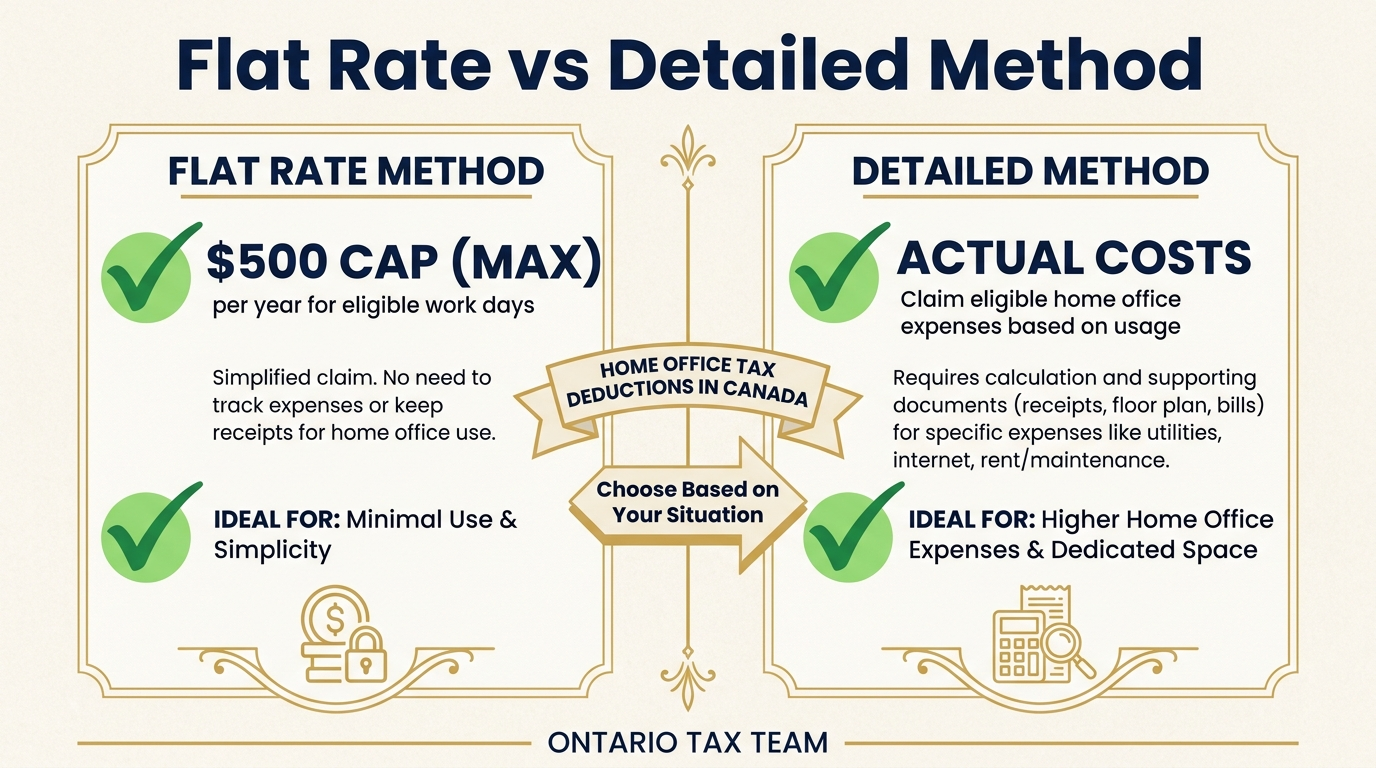
CRA introduced a simplified flat rate method during the pandemic, and a version of it has continued. Under this method:
- You can claim $2 per day for each day you worked from home, up to a maximum of $500 per year
- You don't need receipts, detailed calculations, or a signed T2200 form from your employer
- You simply count the number of qualifying work-from-home days and claim the amount on your return
The flat rate method is convenient, but $500 is the ceiling. If your actual home office expenses are significantly higher - which they often are, especially if you rent - the detailed method is worth the extra effort.
Method 2: The Detailed Method
The detailed method lets you claim the actual costs of maintaining your home workspace, calculated as a percentage of your total home expenses. This method requires more documentation but often produces a much larger deduction.
Calculating Your Business-Use Percentage
Your business-use percentage is based on the portion of your home used for work. The most common approach is to divide the square footage of your workspace by the total square footage of your home. For example, if your office is 150 square feet and your home is 1,500 square feet, your business-use percentage is 10%.
If you don't have a dedicated room, you can use the number of rooms method - one room out of eight rooms equals 12.5%. CRA expects you to use a reasonable and consistent method.
Eligible Expenses for Employees
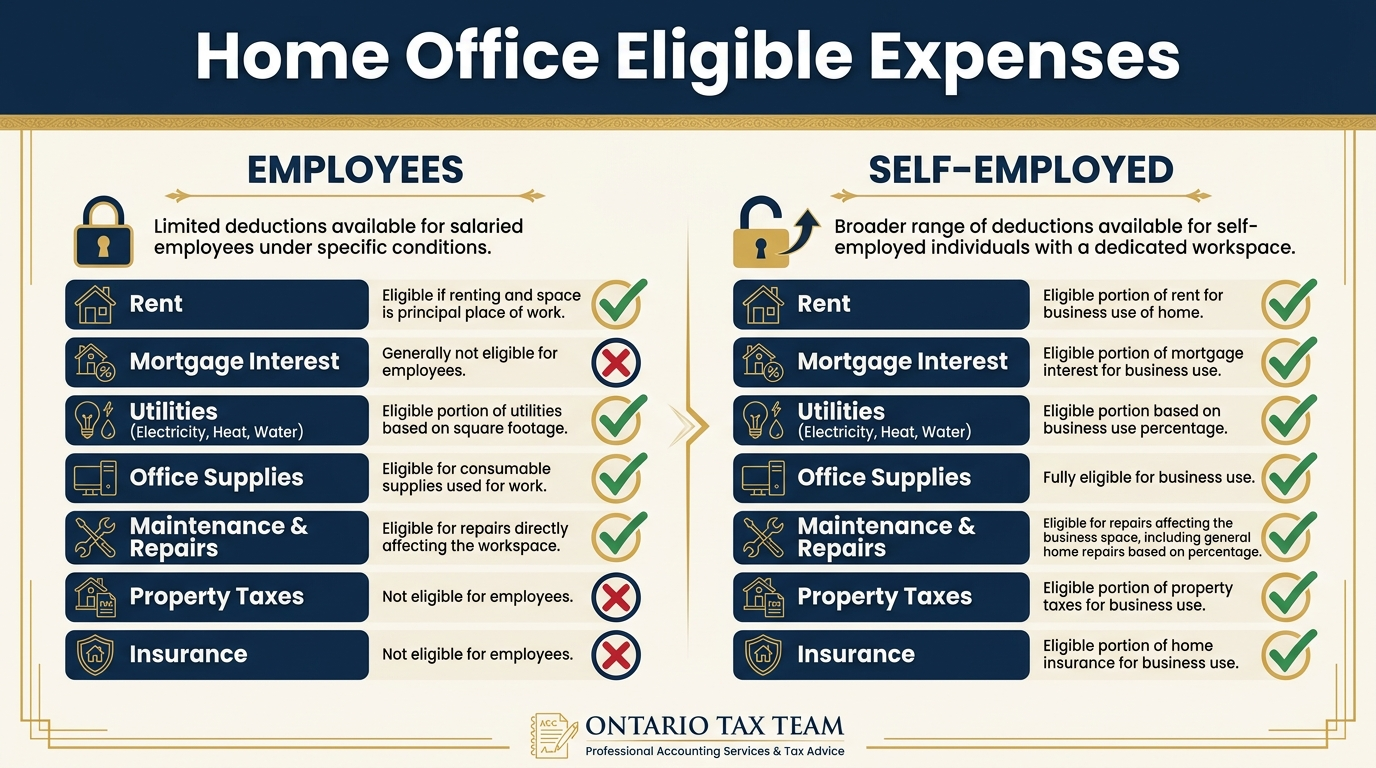
If you're an employee using the detailed method, you can claim your business-use percentage of:
- Electricity, heat, and water
- Internet access fees
- Rent (if you rent your home)
- Minor maintenance and repair costs
- Home insurance premiums (only if your employer requires you to pay these and it's noted on your T2200)
Employees cannot claim mortgage interest, property taxes, or capital cost allowance (CCA) on their home. These deductions are reserved for self-employed individuals.
The T2200 Requirement
To use the detailed method as an employee, you need a T2200 - Declaration of Conditions of Employment signed by your employer. This form confirms that your employer required you to work from home and did not reimburse you for your expenses. Without a signed T2200, CRA will not allow the detailed method deduction.
Ask your employer for this form early - some HR departments are slow to process them, and you don't want to be waiting in April. There is also a shorter version, the T2200S, which was introduced during the pandemic years and may still be accepted. Check the CRA website for the most current form requirements.
Home Office Deductions for Self-Employed Individuals
If you're self-employed, the home office deduction is reported on your T2125 - Statement of Business or Professional Activities. The rules are more generous than for employees. You can claim your business-use percentage of:
- Rent or mortgage interest (not the principal portion of your mortgage payment)
- Property taxes
- Utilities (electricity, heat, water)
- Home insurance
- Internet service
- Maintenance and minor repairs
- Cleaning supplies for the workspace
One important restriction: if you're a sole proprietor, your home office expenses cannot create or increase a business loss. They can only reduce your business income to zero. Any excess carries forward to future years. For a broader look at all the deductions available to you, see our guide on small business tax deductions in Canada and tax deductions for self-employed Canadians.
Source: Canada Revenue Agency home office expense guidelines
Common Mistakes to Avoid
We see these errors frequently when reviewing clients' tax returns:
- Claiming CCA on your home as an employee. Only self-employed individuals can claim capital cost allowance on their home, and even then it's generally not recommended because it can trigger a capital gain when you sell your home and reduce your principal residence exemption.
- Forgetting the T2200. If you're an employee and you don't have a signed T2200, CRA can deny your entire detailed method claim. Get the form before you file.
- Inflating the business-use percentage. CRA is familiar with common home sizes and office setups. Claiming 40% of a 3,000-square-foot home as office space when you use one bedroom will raise flags.
- Not keeping receipts. Proper bookkeeping is essential - the detailed method requires you to have receipts for every expense you claim. “I paid about $200 a month for utilities” is not sufficient documentation. Keep your utility bills, internet invoices, and insurance statements.
- Using the flat rate when the detailed method would save more. Many people default to the $2/day flat rate because it's easy. If you rent a $2,000/month apartment and your office takes up 15% of the space, your rent alone would produce a $3,600 deduction - far more than the $500 flat rate cap.
- Claiming personal-use portions. If you share your workspace with your family in the evenings, you may need to further prorate your business-use percentage to reflect only the hours the space is used for work.
Record Keeping Tips
Good records make or break a home office claim. Here's what to keep on file:
- Measurements of your workspace and total home (or a copy of your floor plan)
- Monthly utility bills, internet invoices, and insurance statements
- Rent receipts or mortgage statements showing interest paid
- Property tax notices
- Your signed T2200 (employees) or a log of your work-from-home days
- Receipts for any maintenance or repairs to the workspace
CRA can request supporting documentation at any time within six years of filing - read our CRA audit guide for what to expect. Having everything organized means a CRA review is an inconvenience rather than a crisis. For self-employed professionals, proper record keeping is especially critical since you don't have an employer vouching for your work arrangement.
Bottom Line
The home office deduction is one of the most valuable and most underused deductions available to Canadians who work from home. Use our tax calculator to see how the deduction affects your bottom line. Whether you use the simple flat rate method or the more detailed calculation, claiming your legitimate home office expenses reduces your taxable income and puts money back in your pocket.
If you're not sure which method is right for you or whether your situation qualifies, Ontario Tax Team can review your circumstances and ensure you claim the maximum deduction you're entitled to. Reach out for professional tax preparation and get it done right.
Key Takeaways
- •You qualify if you worked from home more than 50% of the time or regularly met clients at your home office
- •The flat rate method ($2/day, max $500) is simple but the detailed method often produces a much larger deduction
- •Employees need a signed T2200 from their employer to use the detailed method
- •Self-employed individuals can claim mortgage interest and property taxes; employees cannot
- •Keep detailed records including measurements, utility bills, and receipts for at least six years
Need Help Claiming Home Office Deductions?
Our tax team ensures you claim the maximum home office deduction using the method that saves you the most. Book a free 15-minute consultation.