Being self-employed comes with a lot of freedom - and a lot of tax deductions most people don't fully take advantage of. Unlike salaried employees, self-employed individuals can deduct a wide range of business expenses directly against their income, significantly lowering their taxable income and the amount they owe CRA. The key is knowing what qualifies, how to calculate each deduction, and what documentation to keep. This guide covers every major deduction available to self-employed Canadians in 2026.
Home Office Expenses
If you work from home, you can deduct a portion of your household expenses as a business expense. For a detailed walkthrough, see our guide on home office tax deductions in Canada. There are two methods for calculating this deduction, and you should use whichever gives you the larger claim.
Detailed Method (Form T2125)
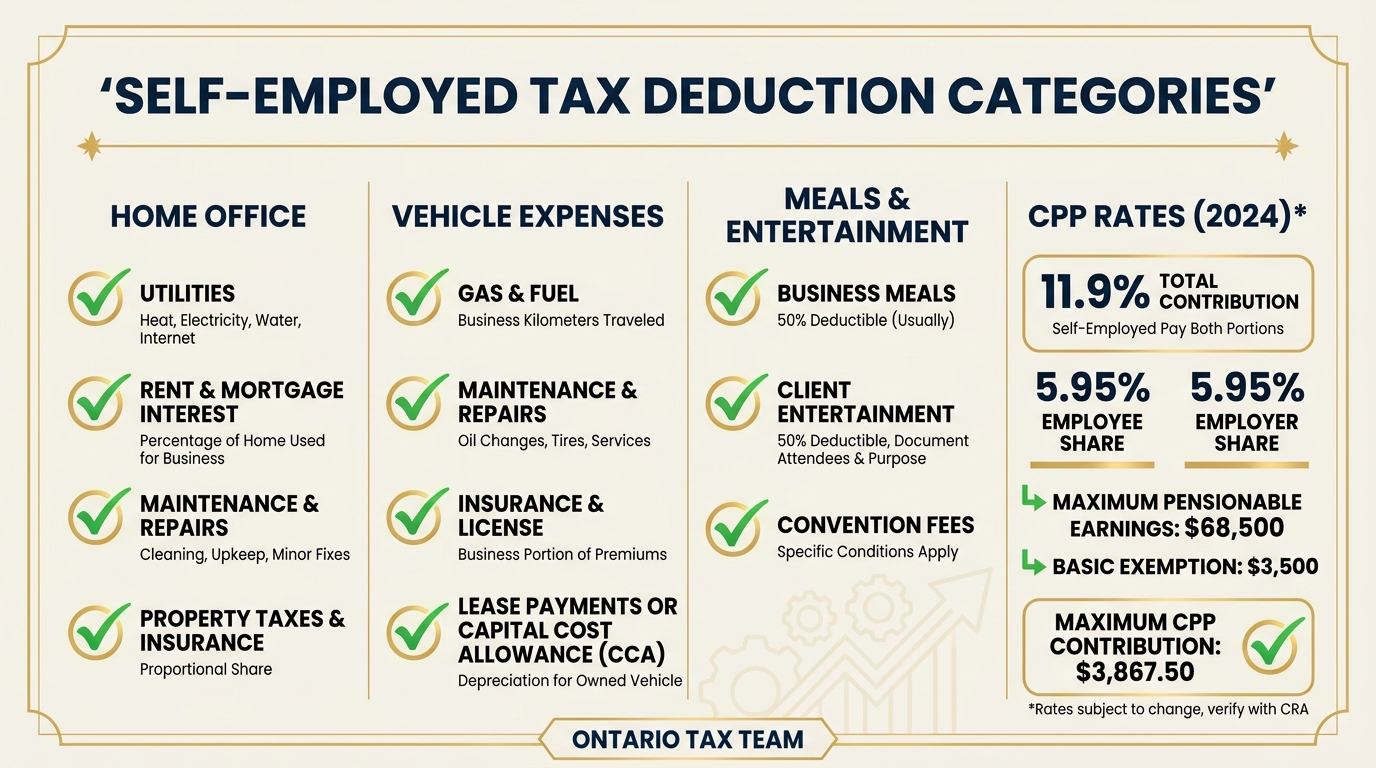
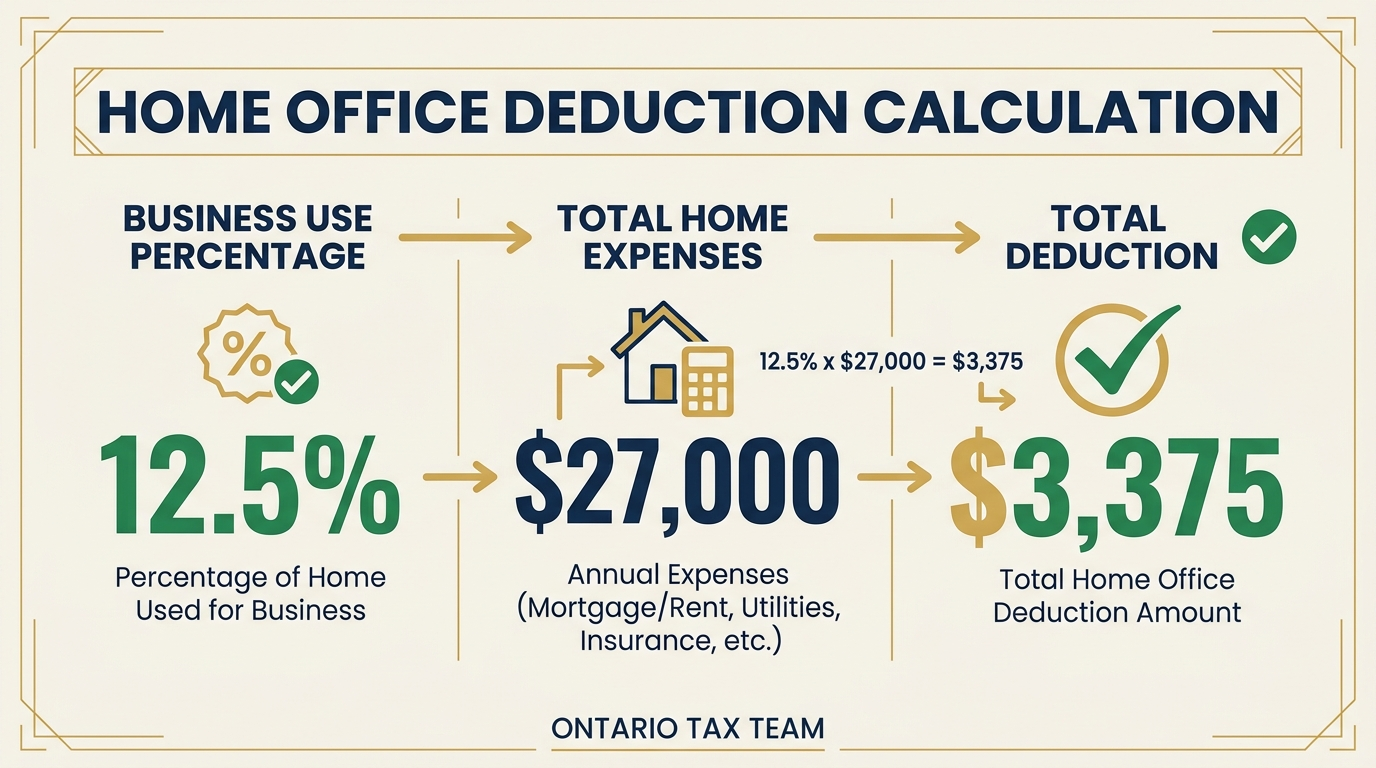
Under the detailed method, you calculate the percentage of your home that you use for business - typically based on the square footage of your workspace divided by the total square footage of your home. You then apply that percentage to eligible household expenses:
- Rent (if you rent) or mortgage interest (not principal)
- Property taxes
- Utilities (heat, electricity, water)
- Home insurance
- Maintenance and minor repairs
- Internet (business-use portion)
For example, if your home office is 200 square feet in a 1,600-square-foot home, your business-use percentage is 12.5%. If your total eligible household expenses are $24,000 per year, you can deduct $3,000. An important limitation: your home office deduction cannot create or increase a business loss. If your business has a loss before the home office deduction, you carry the unused portion forward to a future year.
Flat Rate Method
CRA introduced a temporary flat rate method during the pandemic, allowing a deduction of $2 per day worked from home (up to a maximum). While the flat rate is simpler, the detailed method almost always produces a larger deduction for self-employed individuals with dedicated home offices. Your tax preparer can calculate both and use the better result.
Vehicle Expenses
If you use your personal vehicle for business, you can deduct the business-use portion of your vehicle expenses. This includes:
- Fuel
- Insurance
- Maintenance and repairs
- Licence and registration fees
- Lease payments (subject to limits) or capital cost allowance (CCA) on a purchased vehicle
- Parking fees and supplementary business insurance
The Logbook Requirement
CRA expects you to maintain a logbook that records the date, destination, purpose, and kilometres driven for each business trip. At the end of the year, you calculate your business-use percentage (business kilometres divided by total kilometres) and apply it to your total vehicle expenses. Without a logbook, CRA can deny your entire vehicle deduction in an audit. There are several smartphone apps that make this easy - the important thing is to track consistently from January 1.
As a practical tip, CRA accepts a simplified logbook approach: keep a detailed logbook for one complete year to establish your business-use percentage, and then track a representative three-month sample in subsequent years to confirm the percentage hasn't changed significantly.
Advertising and Marketing
All reasonable advertising and marketing expenses are fully deductible. This includes website hosting, domain registration, social media advertising, Google Ads, business cards, brochures, signage, trade show fees, and SEO services. If you pay for a listing in a professional directory or sponsor a local event for business exposure, those costs are deductible too.
Professional Development and Education
Courses, workshops, conferences, and certifications that are directly related to your current business are deductible. The training must maintain or improve skills you already use in your business - it cannot be for entering an entirely new field. The cost of professional books, subscriptions, and industry publications also qualifies. Travel expenses to attend conferences (including registration fees, transportation, and accommodation) are deductible at the applicable rates.
Software and Technology
Software subscriptions that you use for business are fully deductible in the year you pay for them. This includes accounting software, project management tools, cloud storage, design applications, CRM systems, and any other software necessary for your work. If you purchase computer hardware or equipment, it's typically deducted over time through capital cost allowance rather than expensed immediately, though the Accelerated Investment Incentive may allow you to claim a larger deduction in the first year.
Cell Phone and Internet
If you use your personal cell phone and home internet for business, you can deduct the business-use portion. Keep your monthly statements and estimate a reasonable percentage. If 60% of your cell phone usage is business-related, you can deduct 60% of the monthly bill. CRA is reasonable about this as long as your percentage makes sense given the nature of your business. Good bookkeeping practices make tracking these split expenses straightforward.
Meals and Entertainment
Business meals - meals with clients, suppliers, or business associates where business is discussed - are deductible at 50%. This applies to restaurant meals, takeout, and food purchased for business meetings. The 50% limitation also applies to entertainment expenses like tickets to events if there's a genuine business purpose.
Keep the receipt and note who you dined with and the business purpose. “Lunch with client - discussed Q2 project scope” is sufficient. Meals consumed while travelling for business are also deductible at 50%, even if you're eating alone.
Travel Expenses
When you travel for business purposes, you can deduct transportation (flights, train, rental car), accommodation, and meals (at 50%). You can also deduct incidentals like airport parking, taxi fares, and baggage fees. The travel must have a clear business purpose - attending a conference, meeting a client, or visiting a job site. If you combine business and personal travel, you can only deduct the portion of expenses attributable to the business component.
Professional Fees
Fees paid to accountants, lawyers, consultants, and other professionals for business purposes are fully deductible. This includes your annual accounting and tax preparation fees, legal fees for drafting contracts, and consulting fees for business advice. Even the cost of tax software, if you prepare your own return, qualifies.
Insurance
Business insurance premiums are fully deductible. This includes general liability insurance, professional liability (errors and omissions) insurance, cyber liability insurance, and commercial property insurance. If you have a home-based business, the business-use portion of your home insurance is deductible under your home office calculation (don't double-count it).
Bad Debts
If you've invoiced a client and included the amount in your income, but the client never pays and you've made reasonable efforts to collect, you can write off the amount as a bad debt. The key is that you must have already reported the income. You can't deduct a bad debt for work you did but never invoiced. Document your collection efforts in case CRA asks.
CPP Contributions
Self-employed individuals pay both the employer and employee portions of CPP - a combined rate of 11.9% on pensionable earnings between the basic exemption ($3,500) and the maximum pensionable earnings. In 2026, this can exceed $8,000 in total contributions. The employee portion is claimed as a non-refundable tax credit on your T1, and the employer portion is deductible as a business expense on line 22200. Many self-employed individuals overlook the employer-portion deduction, which directly reduces your net income.
Health Spending Account
If you're self-employed and have no employees (or only related employees), you may be able to set up a Private Health Services Plan (PHSP) or Health Spending Account (HSA). Through this structure, medical, dental, and vision expenses for you and your family can become a deductible business expense rather than a personal medical expense credit. The tax benefit is significantly better - a full deduction at your marginal rate versus a 15% federal credit. This strategy requires proper setup, so consult your accountant before implementing it. For more on deductions available to businesses, see our guide on self-employed tax filing in Ontario.
Other Commonly Overlooked Deductions
- Bank fees and interest: Monthly account fees, credit card annual fees (business card), and interest on money borrowed for business purposes
- Office supplies: Stationery, printer ink, postage, and general office supplies
- Subcontractor payments: If you hire freelancers or subcontractors, their fees are fully deductible
- Professional memberships: Annual dues for industry associations, chambers of commerce, and professional regulatory bodies
- Moving expenses: If you move at least 40 kilometres closer to your new business location, moving costs may be deductible
Bottom Line
Self-employed Canadians have access to an extensive list of deductions that can dramatically lower their tax bill. The common thread is that the expense must be reasonable, incurred to earn business income, and properly documented. Keep receipts, maintain a logbook for vehicle use, and track the business-use percentage for shared expenses like your home and phone. Working with a professional accountant ensures you claim everything you're entitled to without crossing the line into claims CRA would challenge. If you're considering whether to stay self-employed or incorporate, see our guide on incorporation vs sole proprietorship.
Key Takeaways
- •The detailed home office method almost always gives a larger deduction than the flat rate for self-employed individuals
- •Keep a vehicle logbook from January 1 - CRA can deny your entire vehicle claim without one
- •Business meals are deductible at 50%; note the attendee and business purpose on each receipt
- •Don't forget the employer portion of CPP - it's a deductible business expense, not just a credit
- •A Health Spending Account can convert personal medical expenses into a full business deduction
Need Help Maximizing Your Deductions?
Our tax team ensures self-employed Canadians claim every legitimate deduction and pay only what they owe. Book a free 15-minute consultation.