
If you've ever worked as an employee in Canada, you've received a T4 slip. It's one of the most common tax documents Canadians encounter, yet many people don't fully understand what the numbers on it mean or how they affect their tax return. This guide breaks down the T4 slip box by box so you know exactly what you're looking at.
What Is a T4 Slip?
The T4 - officially called the “Statement of Remuneration Paid” - is a tax information slip that your employer issues to report the employment income they paid you during the calendar year and the amounts deducted for income tax, CPP contributions, and EI premiums.
Employers are required to issue T4 slips to employees and file them with CRA. The information on your T4 is what CRA uses to verify the income and deductions you report on your personal tax return.
When Do You Receive Your T4?
Employers must provide T4 slips to employees by the last day of February following the calendar year. So for the 2025 tax year, your employer must issue your T4 by February 28, 2026. For more on key tax dates, see our guide on when taxes are due in Canada.
Many employers now distribute T4s electronically through their payroll system or online portal. If you haven't received yours by mid-March, contact your employer. You can also access your T4 through CRA's My Account once it's been filed, though this may take a few weeks after the employer submits it.
Key Boxes on the T4 Slip
The T4 slip contains dozens of numbered boxes, but most employees only need to focus on a handful. Here are the most important ones:
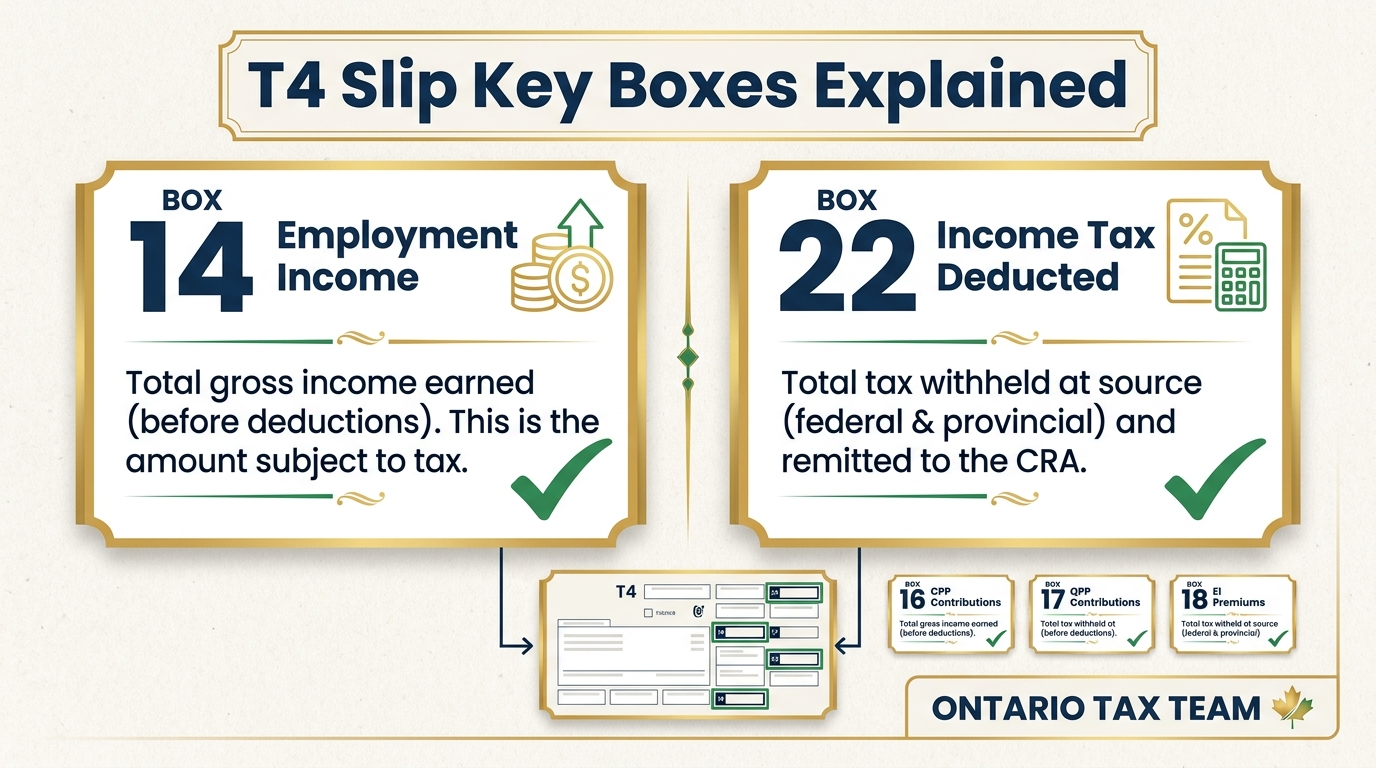
Source: Canada Revenue Agency T4 guide
Box 14 - Employment Income
This is the big number. Box 14 shows your total employment income before any deductions. It includes your regular salary or wages, overtime, vacation pay, bonuses, commissions, and most taxable benefits. This is the amount you report as employment income on line 10100 of your T1 tax return.
Box 16 - Employee's CPP Contributions
This shows how much you contributed to the Canada Pension Plan during the year. For a deeper look at these deductions, see our guide on payroll deductions in Canada. For 2025, the employee CPP contribution rate is 5.95% on pensionable earnings between the basic exemption ($3,500) and the first earnings ceiling. You claim this amount as a tax credit on your return.
Box 18 - Employee's EI Premiums
This is the amount deducted from your pay for Employment Insurance premiums. For 2025, the employee EI rate is 1.64% on insurable earnings up to the maximum insurable amount. Like CPP, your EI premiums generate a tax credit.
Box 22 - Income Tax Deducted
This box shows the total federal and provincial income tax your employer withheld from your pay throughout the year. This amount is applied as a credit when you file your tax return. If too much was deducted, you get a refund. If too little was withheld, you'll owe the difference.
Box 24 - EI Insurable Earnings
This is the total earnings on which your EI premiums were calculated. It's often the same as Box 14 but can differ if some of your income isn't insurable or if you exceeded the annual maximum insurable earnings.
Box 26 - CPP Pensionable Earnings
Similar to Box 24 but for CPP. This shows the earnings on which your CPP contributions were based. It may differ from Box 14 if some income types are excluded from CPP or if you exceeded the annual maximum pensionable earnings.
Box 40 - Other Taxable Allowances and Benefits
This box captures taxable benefits that aren't part of your regular salary - things like personal use of a company vehicle, employer-paid group life insurance premiums above $25,000, or certain housing allowances. The amount in Box 40 is already included in Box 14.
Box 44 - Union Dues
If you're a union member, this shows the total union dues deducted from your pay during the year. Union dues are tax-deductible and can be claimed on line 21200 of your tax return.
Box 46 - Charitable Donations
Some employers facilitate charitable giving through payroll deductions. If so, the total donated amount appears here. You can claim these donations as a tax credit, but make sure you have the corresponding donation receipts.
What to Do If Your T4 Is Wrong
Mistakes happen. If you notice that the income or deductions on your T4 don't match your own records (pay stubs, direct deposit amounts, etc.), contact your employer immediately and ask for a corrected T4.
Common T4 errors include:
- Incorrect total income (Box 14 doesn't match your pay stubs)
- Wrong tax deductions (Box 22 seems too high or too low)
- Missing taxable benefits that should be included
- Incorrect personal information (name, SIN)
Your employer must issue an amended T4 if there's an error. Do not file your tax return with incorrect information - CRA will compare your return against the T4 data your employer filed, and discrepancies can trigger reassessments or delays. To avoid other common errors, read our guide on common tax filing mistakes.
Reporting T4 Income on Your T1
When you file your personal tax return, the key T4 amounts flow to these lines on your T1:
- Line 10100: Employment income (from Box 14)
- Line 30800: CPP contributions (from Box 16)
- Line 31200: EI premiums (from Box 18)
- Line 43700: Total income tax deducted (from Box 22)
- Line 21200: Union dues (from Box 44, if applicable)
If you use tax software, most of these lines are populated automatically when you enter your T4 information. Our tax preparation service handles all of this for you as part of the filing process.
Multiple T4s from Different Employers
If you worked for more than one employer during the year, you'll receive a separate T4 from each. All T4 income must be reported on your tax return. Your total employment income on line 10100 is the sum of Box 14 from every T4 you received.
One thing to watch for with multiple employers: you may have overpaid CPP or EI if both employers deducted the maximum contributions independently. CRA will automatically calculate the overpayment and include it in your refund when you file your return.
T4 vs Other Tax Slips
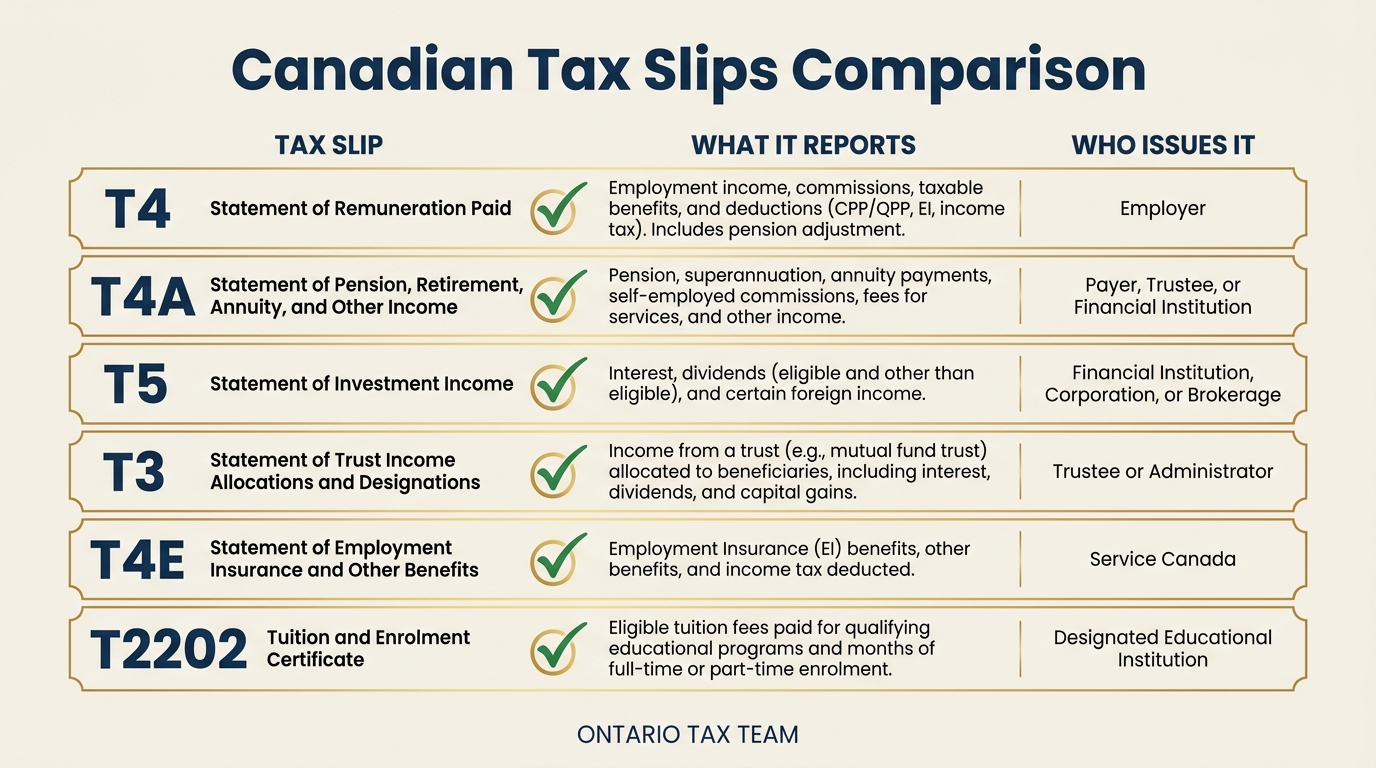
The T4 is specifically for employment income. Other common tax slips include:
- T4A: Pension, retirement, annuity, and other income (including self-employment commissions and subcontractor payments)
- T5: Investment income (interest, dividends)
- T3: Trust income (mutual funds, income trusts)
- T4E: Employment Insurance benefits
- T2202: Tuition and education amounts
Each slip serves a different purpose, but they all report income or deductions that must appear on your personal tax return. Employers who manage payroll are responsible for issuing T4s accurately and on time.
Bottom Line
Your T4 slip is a straightforward document once you understand what each box represents. Review it carefully against your own records each year, report the information accurately on your tax return, and contact your employer promptly if anything looks wrong. Getting this right is the first step toward an accurate, stress-free tax filing. Check your Notice of Assessment after filing to confirm CRA processed your T4 income correctly, and use our tax calculator to estimate your refund or balance owing.
Key Takeaways
- •The T4 reports your employment income, CPP, EI, and income tax deducted for the year
- •Employers must issue T4 slips by the last day of February following the tax year
- •Box 14 (employment income) and Box 22 (tax deducted) are the two most critical boxes for your tax return
- •If your T4 contains errors, contact your employer for a corrected slip before filing
Need Help With Your Tax Return?
Our tax preparation team handles T4 reporting and ensures your return is filed accurately. Book a free 15-minute consultation.