“Should I put my money in a TFSA or an RRSP?” It's one of the most common personal finance questions Canadians ask, and the answer is almost always “it depends.” Both accounts offer significant tax advantages, but they work in fundamentally different ways. Choosing the right one - or using both strategically - can save you thousands of dollars over a lifetime.
Here's a straightforward comparison to help you figure out which account deserves your dollars first.
How the RRSP Works
A Registered Retirement Savings Plan (RRSP) gives you a tax deduction when you contribute and defers tax until you withdraw. The idea is simple: you contribute during your high-earning years when your marginal tax rate is high, and you withdraw in retirement when your income - and therefore your tax rate - is lower.
Key Features of the RRSP
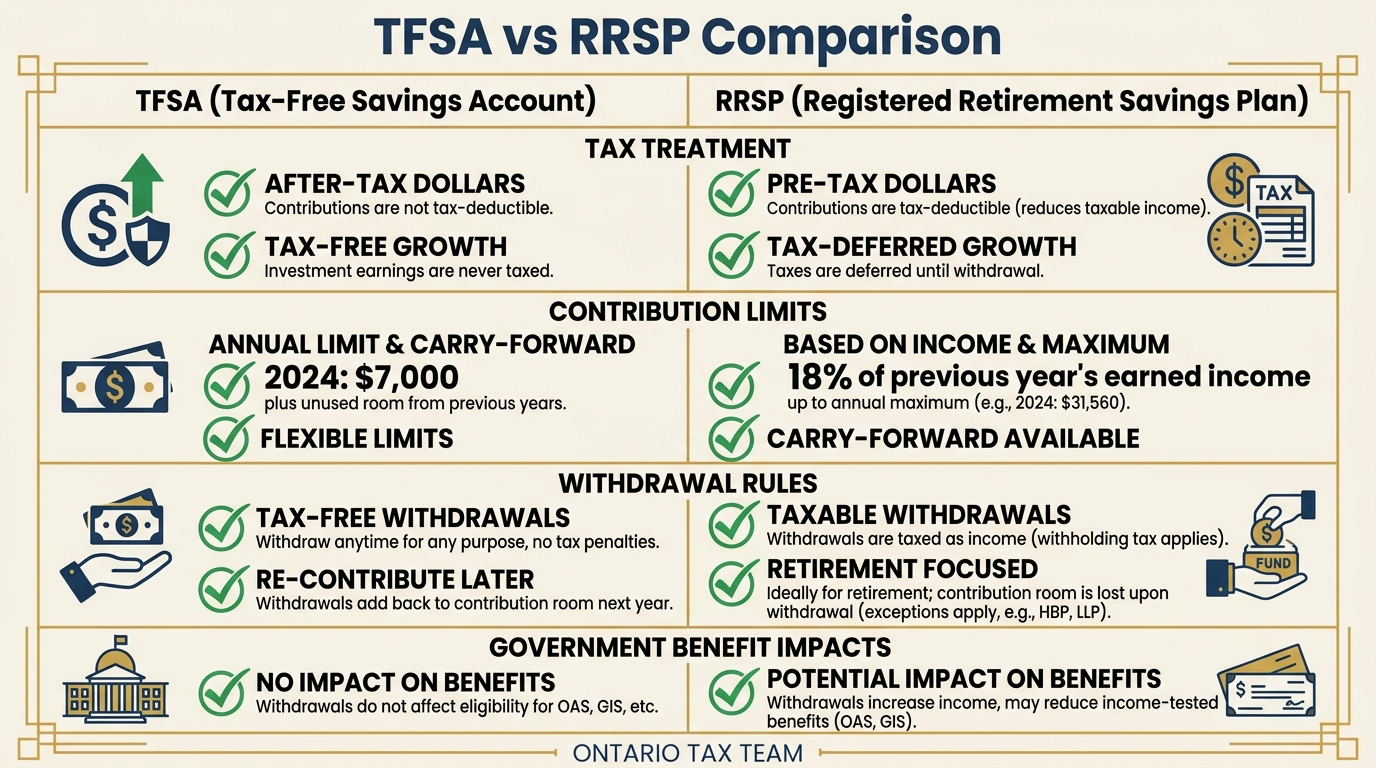
- Contributions are tax-deductible - they reduce your taxable income in the year you contribute
- Investment growth inside the account is tax-sheltered
- Withdrawals are fully taxable as income
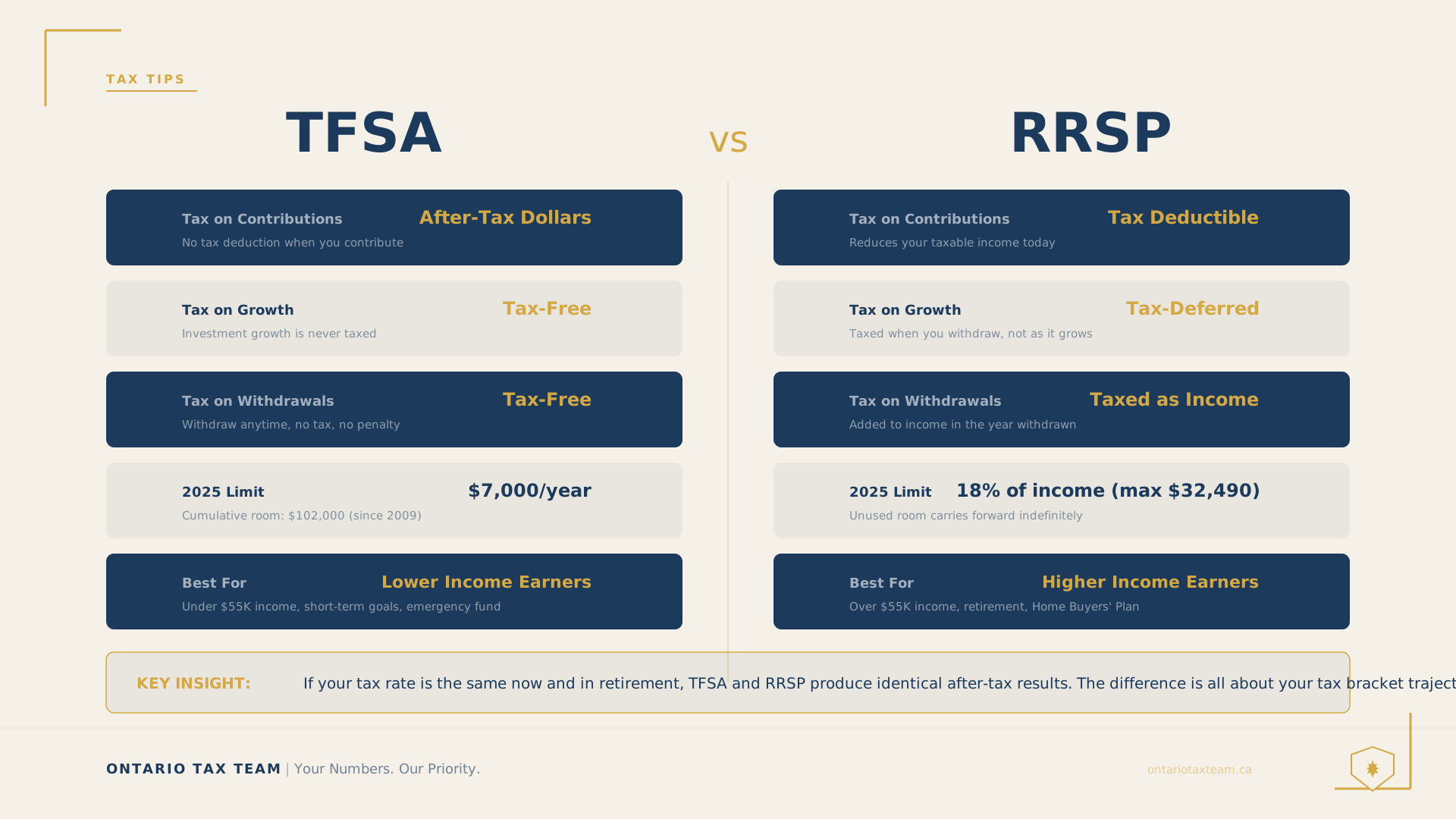
- Contribution limit is 18% of your previous year's earned income, up to the annual maximum ($31,560 for 2024, indexed annually)
- Unused contribution room carries forward indefinitely
- Must convert to a RRIF or annuity by December 31 of the year you turn 71
The RRSP is essentially a tax-deferral tool. You don't avoid paying tax - you delay it to a time when you expect to be in a lower bracket. For detailed strategies on maximizing your RRSP, see our guide on the RRSP contribution deadline and planning tips.
How the TFSA Works
A Tax-Free Savings Account (TFSA) works in the opposite direction. You contribute with after-tax dollars - no deduction upfront - but everything that grows inside the account is completely tax-free, and withdrawals are tax-free too.
Key Features of the TFSA
- Contributions are not tax-deductible
- Investment growth is completely tax-free
- Withdrawals are completely tax-free and do not affect government benefits
- Annual contribution limit is $7,000 (2024 and 2025), with cumulative room building since 2009
- Withdrawn amounts get added back to your contribution room the following year
- No age limit for contributions and no forced conversion
If you've been eligible since the TFSA was introduced in 2009 and never contributed, your total cumulative room is $102,000 as of 2025. That's a significant amount of tax-free investment space most Canadians aren't using.
The Core Difference: When You Pay Tax
The fundamental distinction comes down to timing. With an RRSP, you get a tax break now and pay tax later. With a TFSA, you pay tax now and never pay tax on that money again. This means:
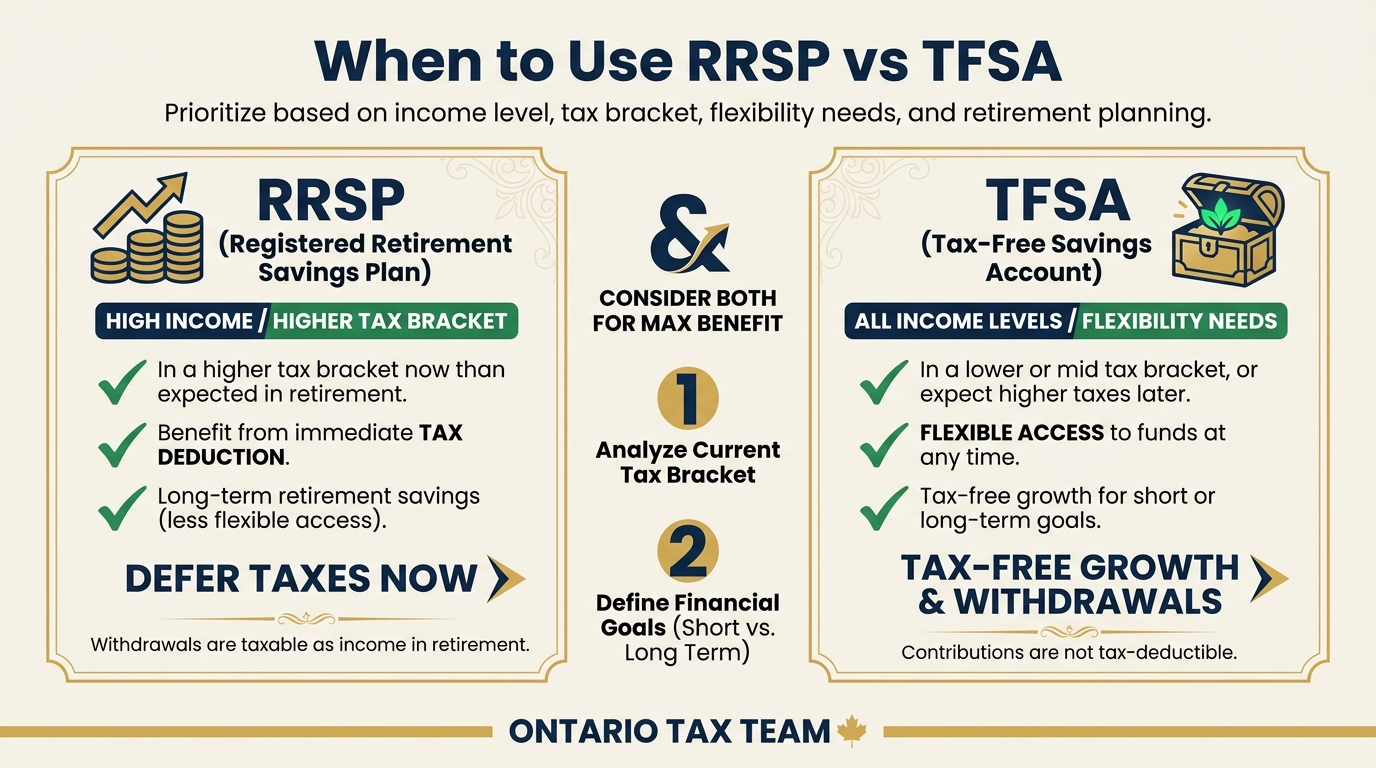
- If your tax rate is higher today than it will be in retirement, the RRSP wins
- If your tax rate is the same or lower today, the TFSA wins
- If you're not sure, the TFSA gives you more flexibility since there are no tax consequences on withdrawal
When the RRSP Is the Better Choice
The RRSP shines in specific situations where the tax deduction delivers meaningful value. Consider prioritizing your RRSP when:
- Your income is high. If you're in a marginal tax bracket of 40% or more in Ontario, the RRSP deduction is worth a lot. Contributing $10,000 could save you $4,000 or more in tax right now.
- You expect lower income in retirement. Most people earn less in retirement than during their peak working years. If that's your situation, the RRSP arbitrage works in your favour.
- You're buying your first home. The Home Buyers' Plan lets you withdraw up to $60,000 from your RRSP tax-free to buy a qualifying home (repayable over 15 years).
- Your employer offers RRSP matching. If your employer matches contributions, that's free money. Always contribute enough to get the full match before considering other options.
A solid tax planning strategy can help you determine the optimal RRSP contribution amount based on your specific tax bracket and retirement projections.
When the TFSA Is the Better Choice
The TFSA is often the smarter first choice for more Canadians than you might expect. Prioritize your TFSA when:
- Your income is modest. If you're in a low tax bracket, the RRSP deduction doesn't save you much. You're better off paying the small amount of tax now and enjoying tax-free growth and withdrawals forever.
- You've already maxed out your RRSP. Once you've hit your RRSP contribution limit, the TFSA is the next best tax-sheltered account available to you.
- You need flexibility. TFSA withdrawals are penalty-free and don't affect your eligibility for income-tested government benefits like OAS, GIS, or the Canada Child Benefit. RRSP withdrawals do.
- You're saving for a short-term goal. Because you can withdraw from a TFSA at any time without tax consequences, it's ideal for saving for a car, vacation, emergency fund, or down payment.
- You're retired or near retirement. Contributing to an RRSP in retirement rarely makes sense. The TFSA lets you continue sheltering investment income without worrying about future mandatory withdrawals.
Using Both Together
The best strategy for many Canadians is to use both accounts strategically. Here's a common approach that works well:
- Contribute to your RRSP to bring your taxable income down to a lower bracket
- Take the RRSP tax refund and invest it in your TFSA
- Use the TFSA for shorter-term goals and the RRSP for long-term retirement savings
This approach gives you the immediate tax deduction from the RRSP while also building a pool of tax-free savings in the TFSA. Over 20 or 30 years, the compounding inside both accounts can be substantial. For more ideas on reducing your overall tax bill, read our guide on how to reduce your personal taxes in Ontario.
Common Mistakes to Avoid
We see these errors regularly when working with clients on their personal income tax returns:
- Over-contributing to your TFSA. CRA charges a 1% per month penalty on excess contributions. Track your room carefully, especially if you've made withdrawals and re-contributions in the same year. Check your Notice of Assessment for your exact TFSA room.
- Using RRSP deductions in a low-income year. You can contribute to your RRSP now and defer the deduction to a future year when your income is higher. Many people don't realize this is an option.
- Ignoring the impact on government benefits. RRSP withdrawals count as income and can claw back OAS, GIS, and other benefits in retirement. TFSA withdrawals do not.
- Holding cash in a TFSA. A TFSA can hold stocks, bonds, ETFs, GICs, and mutual funds - not just savings accounts. Holding only cash means you're wasting the tax-free growth potential on capital gains and dividends.
- Not contributing at all. The worst mistake is analysis paralysis. If you can't decide between the two, start with the TFSA - you can always move money to an RRSP later, but you can't get back lost TFSA contribution room from years you didn't use.
Bottom Line
There's no single right answer to the TFSA vs RRSP question. The best choice depends on your current income, expected retirement income, need for flexibility, and overall financial goals. For high-income earners, the RRSP usually comes first. For lower-income earners or those who value flexibility, the TFSA often wins. And for many Canadians, using both accounts together is the most powerful approach.
A qualified accountant can model different scenarios based on your specific situation and help you build a contribution strategy that minimizes your lifetime tax bill. At Ontario Tax Team, we help clients across Ontario with personalized tax planning that goes beyond the basics.
Key Takeaways
- •RRSPs give you a tax deduction now but withdrawals are taxed; TFSAs offer no upfront deduction but withdrawals are completely tax-free
- •High-income earners generally benefit more from the RRSP; lower-income earners often benefit more from the TFSA
- •TFSA withdrawals don't affect government benefits like OAS and GIS, while RRSP withdrawals do
- •Using both accounts together - RRSP for the deduction, TFSA for flexibility - is often the best strategy
- •Avoid over-contributing to your TFSA, and consider deferring RRSP deductions to higher-income years
Need Help With TFSA and RRSP Planning?
Our tax planning team helps you build a contribution strategy that minimizes your lifetime tax bill. Book a free 15-minute consultation.