
Most business owners know that incorporation is “something they should look into eventually,” but figuring out the right time is where things get murky. Incorporate too early and you're paying for unnecessary complexity. Wait too long and you're leaving money on the table - or worse, exposing yourself to personal liability you could have avoided.
This guide walks you through the practical signs that it's time to incorporate, what the process actually involves, and the costs you should expect. If you're looking for a broader comparison of business structures, start with our guide on incorporation vs sole proprietorship.
Signs It's Time to Incorporate
There's no magic revenue number that triggers incorporation, but there are clear signals. If two or more of the following apply to you, it's worth having a serious conversation with your accountant:
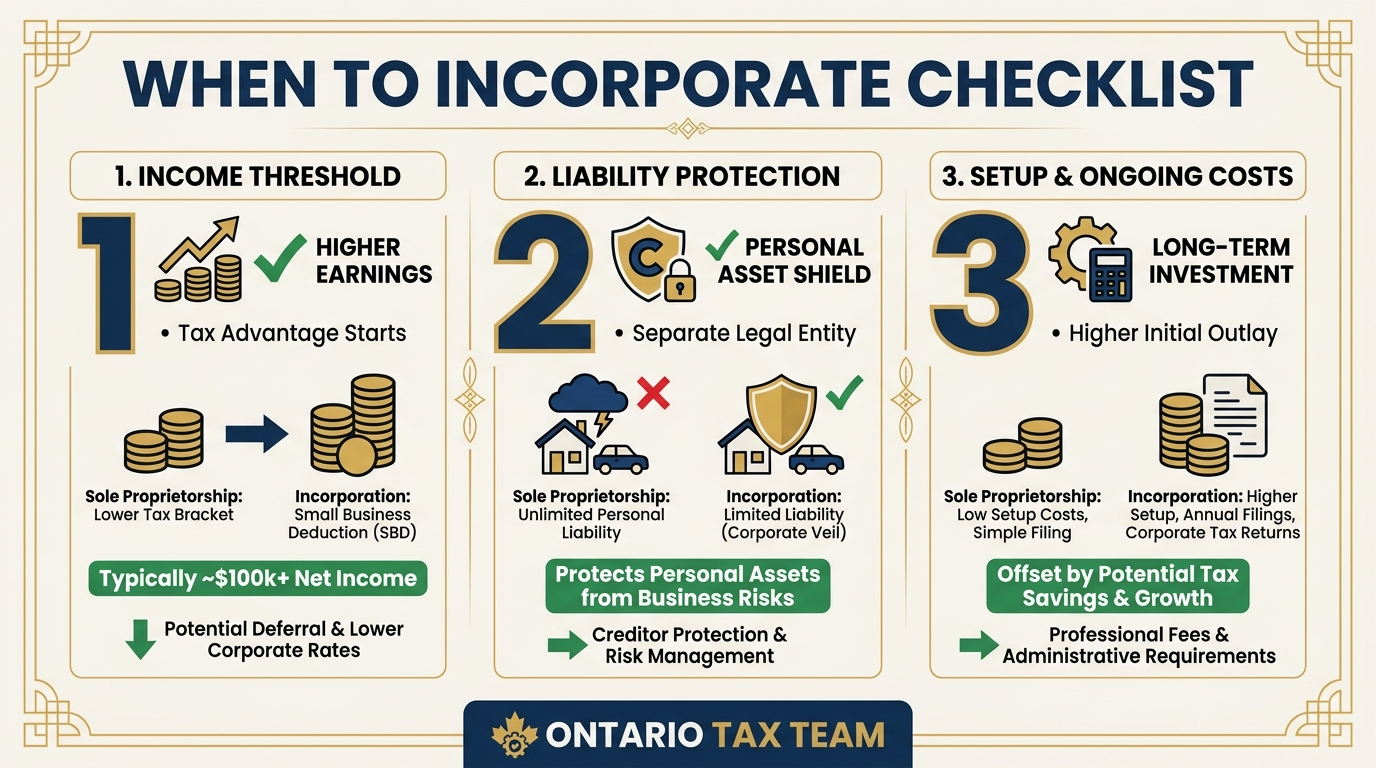
Your Net Business Income Exceeds $80,000-$100,000
This is the most common trigger. In Ontario, the combined federal and provincial small business tax rate on the first $500,000 of active business income is approximately 12.2%. Compare that to a sole proprietor earning $100,000, who pays a marginal personal tax rate of roughly 33-37% on the top portion of that income - use our tax calculatorto see your rate. The difference is significant - but only if you don't need to withdraw all of the profit personally. If every dollar of business income goes straight into your pocket, the tax savings from incorporating shrink considerably because you'll pay personal tax on dividends or salary anyway.
You Don't Need to Withdraw All Your Profits
Incorporation's biggest tax advantage comes from the ability to leave money inside the corporation. Retained earnings grow at the lower corporate tax rate, and you only pay personal tax when you withdraw them as salary or dividends. If your business consistently earns more than you need to live on, a corporation lets you defer that personal tax - potentially for years.
You Have Liability Exposure
As a sole proprietor, you and your business are legally the same entity. If your business is sued, your personal assets - home, savings, investments - are on the line. A corporation is a separate legal entity. While directors can still face personal liability in certain situations (unpaid HST, payroll remittances, environmental issues), the general shield a corporation provides is meaningful for businesses with contracts, employees, or physical products.
You Want Business Credibility
Some clients, government contracts, and business partners require you to be incorporated. Having “Inc.” or “Corp.” after your business name signals permanence and professionalism. It can also make it easier to open business bank accounts and credit facilities.
The Incorporation Process in Ontario
If you've decided it's time, here's what the process looks like. A business incorporation service can handle all of these steps for you:
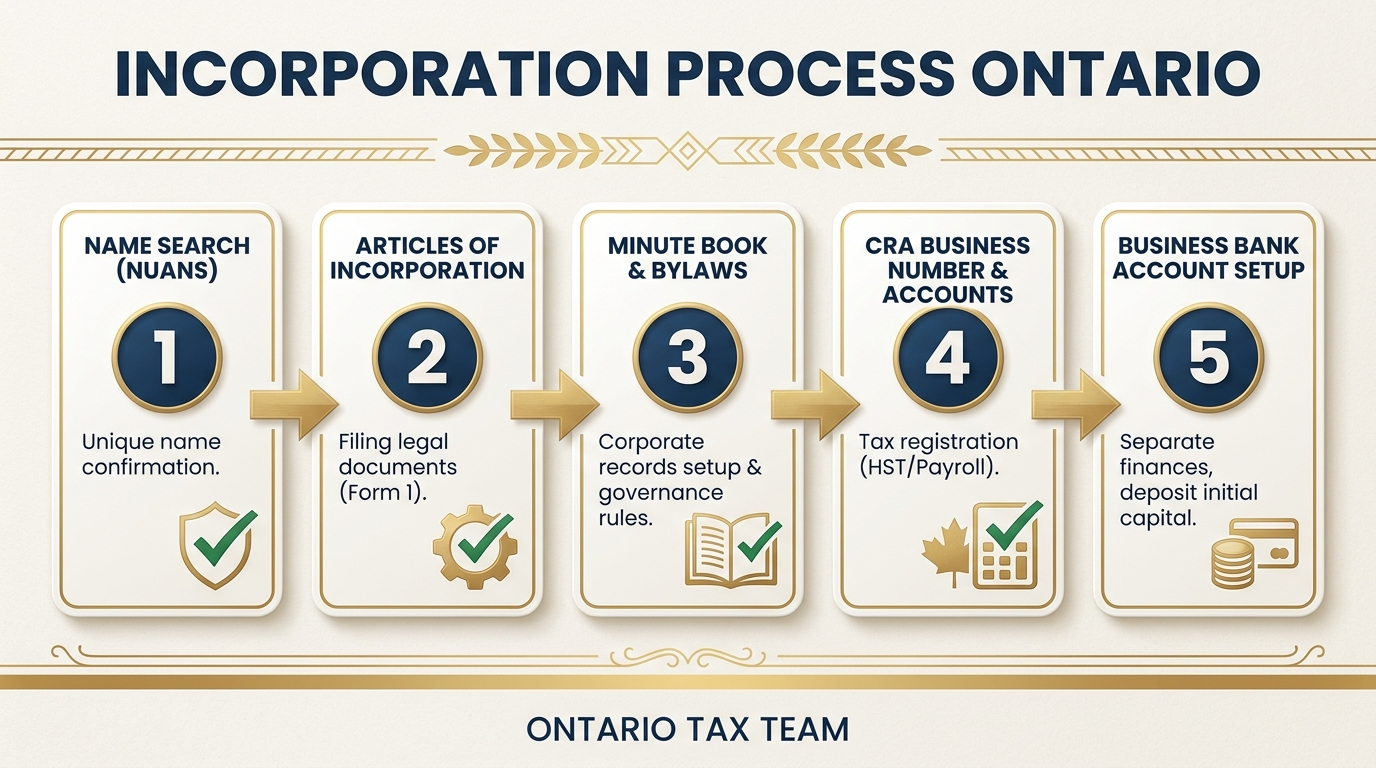
Step 1: Choose a Business Name
You'll need a name search (called a NUANS report) to confirm your proposed business name is available. This report costs around $30 and is valid for 90 days. Alternatively, you can incorporate with a numbered company (e.g., “12345678 Ontario Inc.”) and register a business name separately.
Step 2: File Articles of Incorporation
You file your articles of incorporation with either the Ontario government or the federal government (more on this distinction below). The articles define your share structure, the number and type of directors, and any business activity restrictions.
Step 3: Set Up Your Corporate Records
Every Ontario corporation must maintain a minute book containing your articles, bylaws, organizational resolutions, share certificates, and a register of directors and shareholders. This is a legal requirement, not optional.
Step 4: Register with CRA
Your new corporation needs a Business Number (BN) from CRA, plus any applicable program accounts - HST, payroll, and corporate income tax. If your corporation will earn more than $30,000 in revenue over four consecutive calendar quarters, you must register for HST.
Step 5: Open a Business Bank Account
A corporation must have its own bank account. Co-mingling personal and corporate funds defeats the purpose of incorporating and can jeopardize your liability protection.
Ontario vs Federal Incorporation
You can incorporate under Ontario's Business Corporations Act or the Canada Business Corporations Act. Here's the practical difference:
- Ontario incorporation is simpler and less expensive. The filing fee is around $300 online. Your corporation can operate in Ontario without extra registration. If you want to do business in another province, you'll need to extra-provincially register there.
- Federal incorporation costs around $200 online through Corporations Canada, but you then need to also register extra-provincially in Ontario (and any other province you operate in), which adds cost and paperwork. The benefit is name protection across Canada.
For most small businesses operating primarily in Ontario, provincial incorporation is the straightforward choice. Our business incorporation team can advise on the best option for your situation.
What Does Incorporation Cost?
Here's a realistic breakdown of what you should budget:
- Initial setup: $1,000-$2,500, including government filing fees, NUANS report, articles of incorporation, minute book preparation, and initial organizational resolutions. DIY options exist, but errors in your share structure or articles can be expensive to fix later.
- Annual maintenance: $2,000-$5,000 per year. This covers your annual corporate tax return (T2), annual financial statements, minute book maintenance, and ongoing CRA filings. The cost varies based on the complexity of your business.
- Additional costs: Payroll setup if you pay yourself a salary, annual filing with the Ontario government, and potentially higher accounting and bookkeeping fees due to the separate entity's record-keeping requirements.
The ongoing cost of maintaining a corporation is the most overlooked factor. Many business owners incorporate for the tax savings and then are surprised by the annual compliance costs. Make sure the tax savings outweigh these additional expenses before you proceed.
How Long Does It Take?
Online Ontario incorporation can be completed in as little as one business day. Federal incorporation through Corporations Canada typically takes one to five business days. Getting your CRA Business Number and program accounts set up usually adds another one to two weeks. All in, expect to be fully operational within two to four weeks.
Common Mistakes When Incorporating
We see these issues regularly with clients who incorporated without professional guidance:
- Incorporating too early. If your business earns $40,000 a year and you withdraw all of it, the tax savings from incorporating are negligible - but you're still paying $2,000-$5,000 a year in extra compliance costs.
- Wrong share structure. Your initial share structure affects everything from dividend payments to income splitting to a future sale of your business. Getting it right from the start is far cheaper than fixing it later.
- Neglecting the minute book. Many owners incorporate and never touch their minute book again. CRA, banks, and potential buyers all expect an up-to-date minute book. Catching up on years of neglect is time-consuming and costly.
- Not choosing the right compensation strategy. Should you pay yourself a salary, dividends, or a combination? The answer depends on your personal tax situation, CPP planning, RRSP room, and more. See our guide on salary vs dividends for a detailed breakdown.
- Co-mingling personal and corporate funds. Using the corporate bank account for personal expenses or depositing corporate revenue into a personal account is one of the fastest ways to lose your liability protection.
Bottom Line
Incorporation is a powerful tool, but it's not right for every business at every stage. The ideal time to incorporate is when your income consistently exceeds what you need to live on, when you want liability protection, and when the annual tax savings clearly outweigh the added compliance costs. If you're not sure whether now is the right time, an experienced accountant can model your specific numbers and give you a clear recommendation.
Ontario Tax Team handles the entire incorporation process - from name search to CRA registration - and provides the ongoing corporate tax and compliance support every incorporated business needs.
Key Takeaways
- •Consider incorporating when net business income consistently exceeds $80,000-$100,000 and you don't withdraw everything
- •Ontario incorporation is simpler and cheaper for businesses operating primarily in Ontario
- •Budget $1,000-$2,500 for setup and $2,000-$5,000 per year for ongoing maintenance
- •Get your share structure right from the start - it affects dividends, income splitting, and future sale eligibility
- •Don't incorporate too early - make sure the tax savings outweigh the compliance costs
Thinking About Incorporating?
Our team handles the entire incorporation process and provides ongoing corporate tax support for Ontario businesses. Book a free 15-minute consultation.