If you run a business, you've probably been asked to produce financial statements at some point - by your bank, a potential investor, a landlord, or CRA. And if you're like most business owners, you nodded along while quietly wondering what, exactly, they wanted and why.
Financial statements aren't just paperwork for compliance. They're the clearest picture you'll ever get of your business's financial health, whether you're a newly incorporated companyor an established enterprise. Here's a plain-language breakdown of the three main statements, what each one tells you, and when you need them.
The Three Main Financial Statements
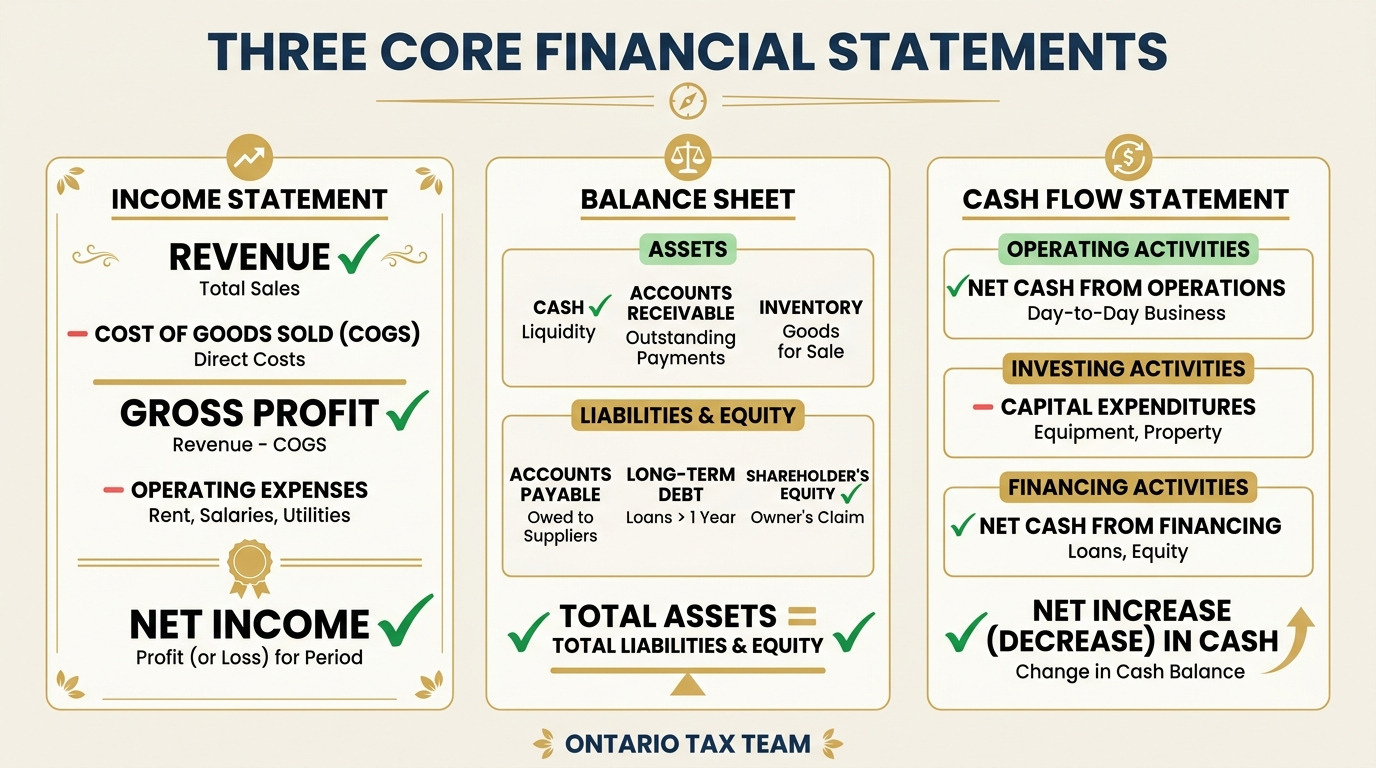
Every set of business financial statements includes three core reports. Each answers a different fundamental question about your business:
- Income Statement (Profit & Loss): How much money did we make or lose over a period of time?
- Balance Sheet: What does the business own, owe, and how much is left for the owners at a specific point in time?
- Cash Flow Statement: Where did the cash come from and where did it go?
The Income Statement
The income statement - also called the profit and loss statement or P&L - covers a specific period (usually a month, quarter, or fiscal year). It starts with revenue at the top and works down through various expenses to arrive at net income (or net loss) at the bottom.
Key Line Items
- Revenue (Sales). Total income from your core business activities before any expenses.
- Cost of Goods Sold (COGS). Direct costs of producing what you sell - materials, direct labour, manufacturing costs. Service businesses may have minimal COGS.
- Gross Profit. Revenue minus COGS. This tells you how much you earn before overhead.
- Operating Expenses. Rent, salaries, utilities, insurance, marketing, professional fees - everything it costs to run the business that isn't directly tied to production. See our full list of deductible business expenses.
- Net Income (or Loss). What's left after all expenses, interest, and taxes. This is the “bottom line.”
The income statement tells you whether your business is profitable and how efficiently you're turning revenue into profit. A business might have strong revenue but weak net income if expenses are too high - the income statement makes that visible immediately.
The Balance Sheet
The balance sheet is a snapshot of your business at a single moment in time. Unlike the income statement, which covers a period, the balance sheet answers: “Right now, what do we own, what do we owe, and what's left?”
The Accounting Equation
Every balance sheet is built on one fundamental equation:
Assets = Liabilities + Equity
This equation always balances - hence the name. If your business owns $500,000 in assets and owes $300,000 in liabilities, the owners' equity is $200,000.
Key Line Items
- Assets. Everything your business owns. Current assets (cash, accounts receivable, inventory) are things you can convert to cash within a year. Non-current assets (equipment, vehicles, buildings) are long-term.
- Liabilities. Everything your business owes. Current liabilities (accounts payable, short-term loans, HST owing) are due within a year. Long-term liabilities (mortgages, long-term loans) are due beyond a year.
- Equity (Shareholders' Equity). The residual value that belongs to the owners. It includes share capital, retained earnings (accumulated profits not yet distributed), and any current-year earnings.
How to Read a Balance Sheet
When reviewing a balance sheet, look for these things:
- Working capital. Current assets minus current liabilities. Positive working capital means you can cover your short-term obligations. Negative working capital is a warning sign.
- Debt-to-equity ratio. Total liabilities divided by total equity. A high ratio means the business is heavily leveraged.
- Cash position. How much cash (or near-cash) is available? A profitable business can still fail if it runs out of cash.
The Cash Flow Statement
The cash flow statement explains why your bank balance changed from the beginning of the period to the end. It's divided into three sections:
- Operating activities. Cash generated (or consumed) by your core business operations. This starts with net income and adjusts for non-cash items like depreciation and changes in working capital.
- Investing activities. Cash spent on (or received from) buying or selling long-term assets like equipment, vehicles, or property.
- Financing activities. Cash from loans, loan repayments, issuing shares, or paying dividends.
The cash flow statement is critical because a business can be profitable on paper (positive net income) while running out of cash in reality. This happens when customers pay slowly, inventory ties up capital, or loan payments consume cash faster than profits grow.
How the Three Statements Connect
The three statements aren't independent - they're interconnected:
- Net income from the income statement flows into retained earnings on the balance sheet
- Net income is also the starting point for the cash flow statement
- The ending cash balance on the cash flow statement matches the cash line on the balance sheet
- Purchases of assets appear on both the balance sheet (as an asset) and the cash flow statement (as an investing outflow)
This is why your accountant prepares all three together. One statement in isolation can be misleading; together they tell the complete story.
NTR vs Review Engagement vs Audit
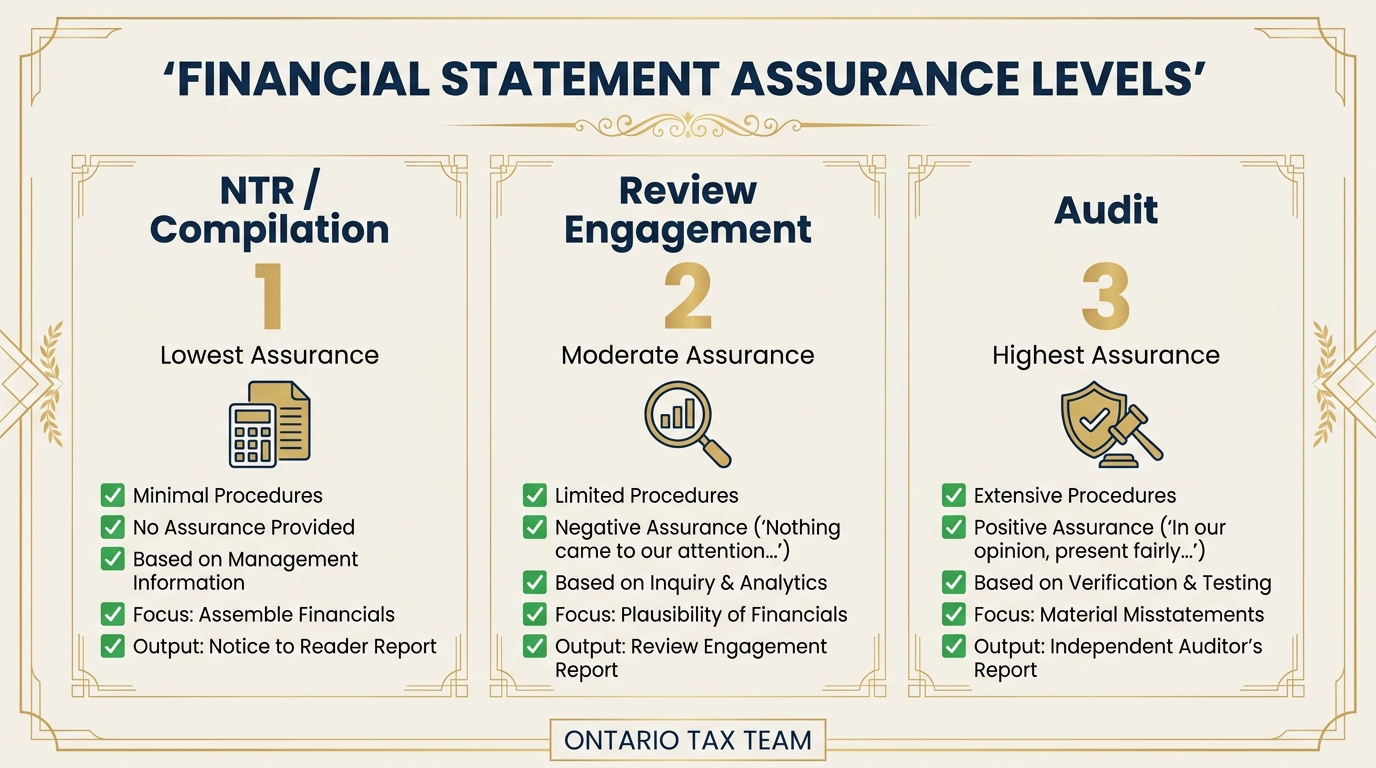
Not all financial statements carry the same level of assurance. In Canada, there are three main levels:
- Notice to Reader (NTR) / Compilation. The accountant compiles financial statements based on information you provide. There's no verification or testing. This is the most common and least expensive option for small businesses. Suitable for internal use and many bank applications.
- Review Engagement. The accountant performs limited procedures - analytical reviews and inquiries - to determine whether the statements are plausible. This provides moderate assurance and is often required by lenders or larger business partners.
- Audit. The most rigorous level. The auditor independently verifies balances, tests transactions, and confirms information with third parties. Required for publicly traded companies, certain non-profits, and businesses above specific revenue thresholds. The most expensive option.
Most small businesses in Ontario only need NTR-level financial statements unless their bank or a contract specifically requires a higher level. Our financial statements team prepares all three levels depending on what your situation demands.
When Do You Need Financial Statements?
There are several situations where you'll need formal financial statements:
- Bank loans and lines of credit. Lenders want to see your income statement, balance sheet, and often a cash flow statement before approving financing.
- Corporate tax filing. Every incorporated business in Canada must file a T2 return with financial statements. CRA uses these to verify the income reported on your tax return.
- Investors and partners. Anyone putting money into your business will want to review your financials before committing.
- Business sale or valuation. Buyers value businesses based on financial statements. Clean, consistent statements make your business more attractive and easier to value.
- Franchise or lease agreements. Many landlords and franchisors require financial statements as a condition of the agreement.
Bottom Line
Financial statements are not just a compliance exercise. They're management tools that tell you whether your business is healthy, where your money is going, and whether you're building long-term value. Accurate bookkeeping throughout the year is what makes reliable financial statements possible. Understanding the basics - even at a high level - makes you a better business owner and a more informed decision-maker.
If you need help preparing or understanding your financial statements, Ontario Tax Team offers financial statement preparation at all assurance levels, tailored to small business owners across Ontario.
Key Takeaways
- •The income statement shows profitability over a period; the balance sheet shows financial position at a point in time
- •The accounting equation (Assets = Liabilities + Equity) is the foundation of every balance sheet
- •A profitable business can still run out of cash - the cash flow statement reveals why
- •Most small businesses only need NTR-level statements unless a lender or contract requires more
- •Financial statements are required for corporate tax filing, bank loans, investors, and business sales
Need Help With Financial Statements?
Our accounting team prepares financial statements at every assurance level for small businesses across Ontario. Book a free 15-minute consultation.