If you run a business in Ontario, HST registration is one of the first compliance tasks you'll face. It's a key item on our new business checklist for CRA, HST, and payroll. Some businesses are required to register, while others choose to register voluntarily because it makes financial sense. Either way, the process is straightforward once you understand the rules. This guide walks you through everything - from figuring out whether you need to register, to actually completing the registration online and collecting your first dollar of HST.
Do You Need to Register for HST?
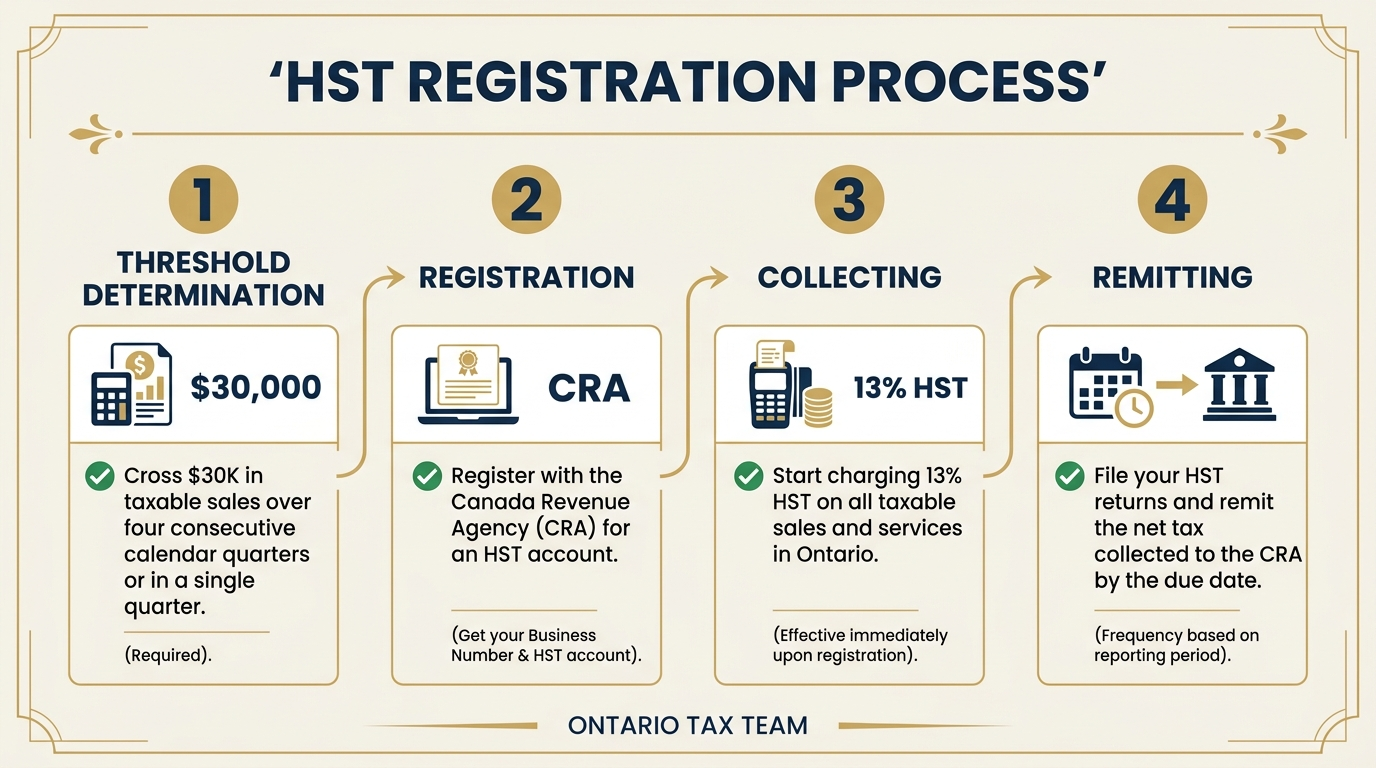
In Canada, you must register for an HST account once your business exceeds $30,000 in worldwide taxable revenue over any single calendar quarter or over four consecutive calendar quarters. This is known as the small supplier threshold. Once you cross it, you have 29 days to register.
The $30,000 threshold applies to most businesses, but there are exceptions. Taxi and ride-sharing drivers must register regardless of revenue. If you're self-employed in Ontario, understanding when registration kicks in is critical. The same applies to non-resident businesses that supply digital products or services to Canadian consumers.
Revenue That Counts Toward the Threshold
Not all revenue counts. Taxable supplies (including zero-rated supplies like basic groceries and exported goods) count toward the $30,000 threshold. Exempt supplies - such as most health care services, residential rent, and financial services - do not count. If you're unsure which category your revenue falls into, it's worth getting professional advice before assuming you're exempt.
Voluntary Registration: Why It Can Make Sense
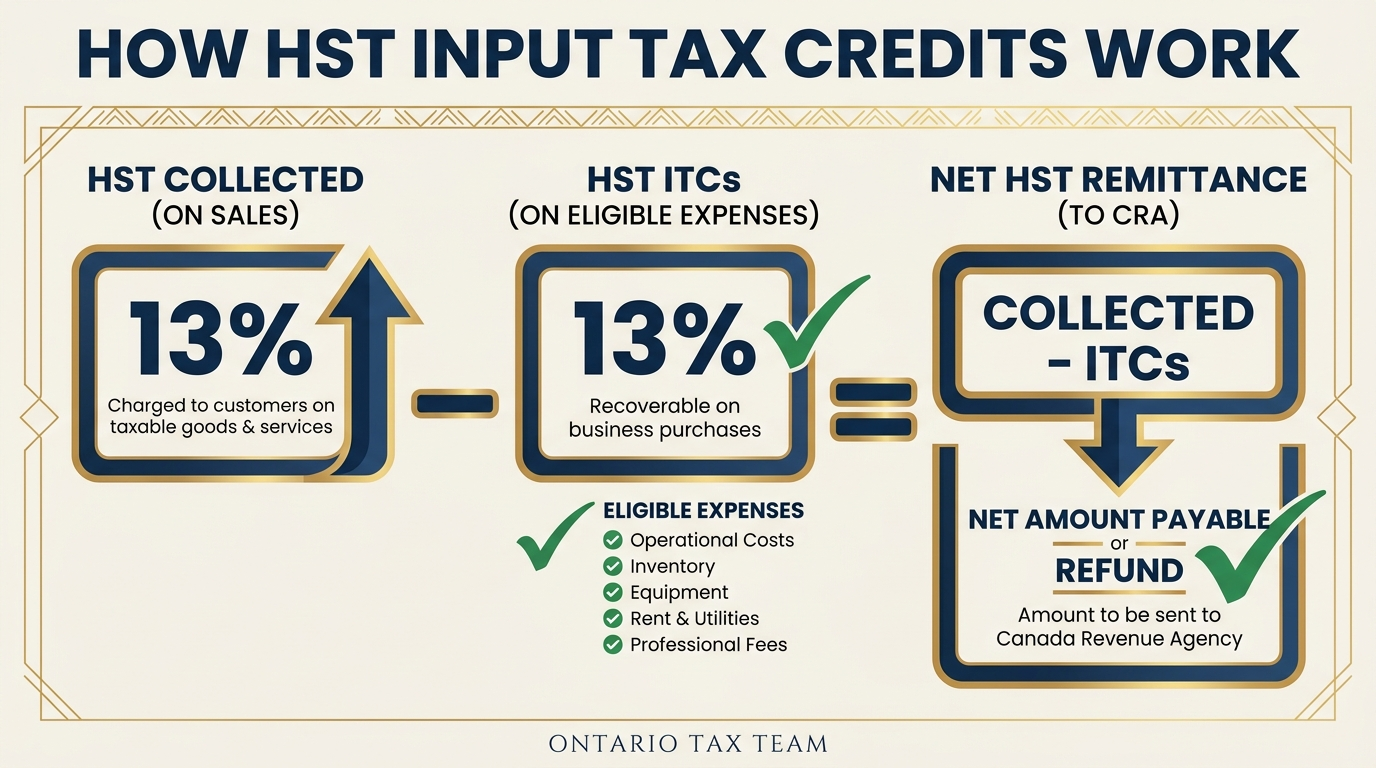
Even if your revenue is below $30,000, you can choose to register voluntarily. Why would you? The main reason is input tax credits (ITCs). Once you're registered, you can claim back the HST you pay on business purchases - supplies, equipment, software subscriptions, professional fees, and more. If your business has significant startup costs or ongoing expenses, the ITCs you recover can easily exceed the administrative burden of collecting and remitting HST.
Voluntary registration also signals professionalism to clients, especially if you work with other HST-registered businesses. They're already paying HST on most of their other vendor invoices, so adding HST to yours is expected. For a deeper look at HST obligations and deadlines, see our HST filing services page.
How to Register Online with CRA
The fastest way to register is through the CRA's Business Registration Online (BRO) service. Here's what you'll need and the steps to follow:
What You'll Need
- Social Insurance Number (SIN): Required for sole proprietors and partners
- Business Number (BN): If you already have one from a previous CRA registration (e.g., payroll, import/export). If not, one will be assigned during the process
- Business information: Legal name, operating name, business address, fiscal year-end date, type of business activity
- Ownership details: Names, SINs, and ownership percentages of all owners
- Expected revenue: An estimate of your annual taxable revenue
Step-by-Step Process
Go to the CRA Business Registration Online page. If you already have a Business Number, log in through My Business Account. If you don't have a BN yet, you can register for one and your HST account at the same time. The online form walks you through entering your business details, selecting the GST/HST program account, and choosing your reporting period and fiscal year-end.
You can also register by phone (1-800-959-5525), by mail using Form RC1, or by having your accountant register on your behalf. The online method is fastest - you'll typically receive your HST number immediately or within a few business days.
Choosing Your Effective Date
When you register, you'll select an effective date for your HST account. If you're registering because you exceeded the $30,000 threshold, the effective date is the day you made the supply that pushed you over. If you're registering voluntarily, you can choose any date - but it cannot be more than 30 days before the date of your registration request.
Choosing the right effective date matters because you can only claim ITCs on purchases made on or after that date. If you have significant recent purchases, talk to your accountant about backdating your effective date within the allowable window. Accurate bookkeeping from day one makes this process much smoother.
Choosing Your Reporting Period
CRA assigns a default reporting period based on your annual revenue, but you can sometimes elect a different one:
- Annual: Default for businesses with taxable revenue of $1.5 million or less. You file one return per year. Simplest option for small businesses.
- Quarterly: Available if revenue is $6 million or less. You file four returns per year. Better cash flow if you regularly receive net refunds.
- Monthly: Available to any registrant. Required if revenue exceeds $6 million. Best for businesses that consistently receive large ITCs.
Most small businesses start with annual filing, which aligns well with their overall tax calendar. For details on filing deadlines for each period, check our guide on HST filing deadlines in Canada.
What Happens After You Register
Once your registration is confirmed, you must start charging HST on your taxable supplies. In Ontario, that means adding 13% HST to your invoices. You're also required to include your Business Number (including the RT identifier) on all invoices so your clients can claim their own ITCs.
You'll collect HST from your customers and remit the net amount to CRA - that is, the HST you collected minus the ITCs you're claiming on eligible business expenses. If your ITCs exceed the HST you collected, CRA sends you a refund.
The Quick Method
If your annual taxable revenue (including HST) is $400,000 or less, you may be eligible for the Quick Method of accounting. Instead of tracking ITCs on every purchase, you remit a flat percentage of your HST-included revenue. For most service businesses in Ontario, the remittance rate is 8.8%. This simplifies your bookkeeping and often results in lower HST remittances than the regular method. Businesses using our HST filing services frequently benefit from this approach.
Common Mistakes to Avoid
- Waiting too long to register: If you've exceeded the threshold, you owe HST from the date of the supply that put you over - even if you haven't registered yet. CRA can assess you retroactively - see our common tax filing mistakes guide.
- Not charging HST after registration: Once registered, you must charge HST on all taxable supplies, even if your customers don't expect it.
- Missing ITC claims: Keep receipts and records for all business expenses. You can only claim ITCs with proper documentation.
- Mixing personal and business expenses: Only business expenses qualify for ITCs. A shared expense (like a home office or vehicle) must be apportioned.
Bottom Line
Registering for HST in Ontario is a straightforward process, but getting the details right - your effective date, reporting period, and method of accounting - can make a meaningful difference to your cash flow and compliance burden. If you're approaching the $30,000 threshold or launching a new business with significant startup costs, don't wait until the last minute. Register proactively, set up your bookkeeping correctly, and start claiming those ITCs from day one. Our Oakville HST filing team can handle the registration and ongoing compliance for you.
Key Takeaways
- •You must register for HST once your taxable revenue exceeds $30,000 over four consecutive quarters or a single quarter
- •Voluntary registration lets you claim ITCs on business expenses even if you're below the threshold
- •Register online through CRA's Business Registration Online for the fastest processing
- •Choose your effective date carefully - you can only claim ITCs from that date forward
Need Help Registering for HST?
Our team handles HST registration, filing, and ongoing compliance so you can focus on your business. Book a free 15-minute consultation.