Starting a business in Ontario involves more than just a good idea and a first client. There's a stack of registrations, accounts, and systems you need to set up - and getting them right from the beginning saves you from expensive corrections later. This checklist walks you through the essential steps in order, from choosing your business structure to understanding your first-year filing deadlines.
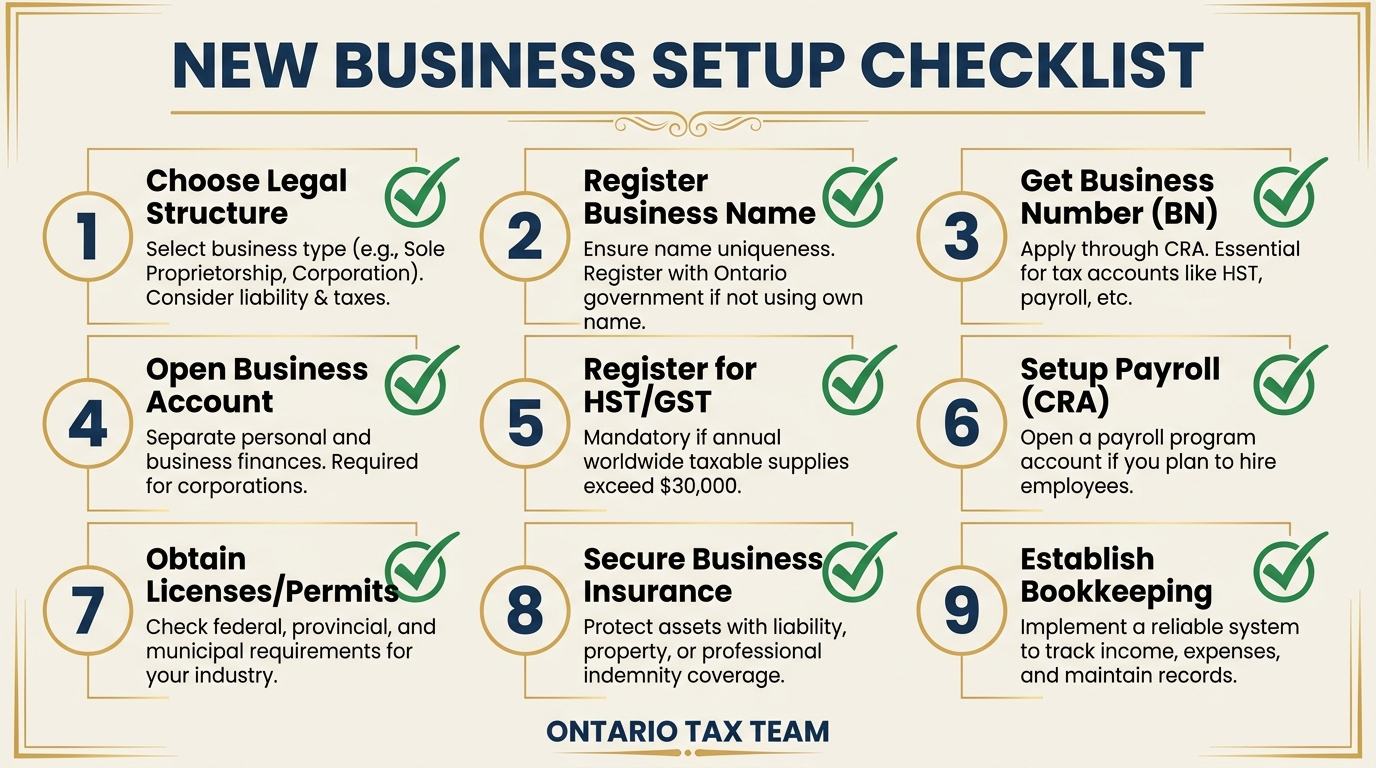
Step 1: Choose Your Business Structure
Before you register anything, decide how your business will be organized. In Ontario, the three most common structures are:
- Sole proprietorship: You and the business are the same legal entity. Simplest to set up, lowest cost, but you're personally liable for everything and taxed at personal rates.
- Partnership: Two or more people sharing ownership. Similar to a sole proprietorship in terms of liability and taxation, but with a partnership agreement governing the relationship.
- Corporation: A separate legal entity that files its own tax return. More expensive to set up and maintain, but offers limited liability, lower tax rates on active business income, and tax deferral opportunities.
If you're not sure which is right for you, our business incorporation serviceincludes a consultation to help you decide. For a sole proprietorship, you register a business name through the Ontario Business Registry for about $60. For incorporation, you'll file articles of incorporation either provincially (Ontario) or federally (Corporations Canada), typically costing $300 to $400 in government fees plus professional fees.
Step 2: Register a Business Number with the CRA
Your Business Number (BN) is the nine-digit identifier the CRA uses to track your business. Every corporation automatically receives a BN when it incorporates. Sole proprietors and partnerships need to register separately, which you can do online through the CRA's Business Registration Online service, by phone, or by mailing Form RC1.
Your BN is the root number. As you register for additional CRA programs - HST, payroll, corporate tax - each one gets a two-letter suffix added to your BN (like RT for HST or RP for payroll). Think of it as one account number with sub-accounts for each obligation.
Step 3: Register for HST (When Required)
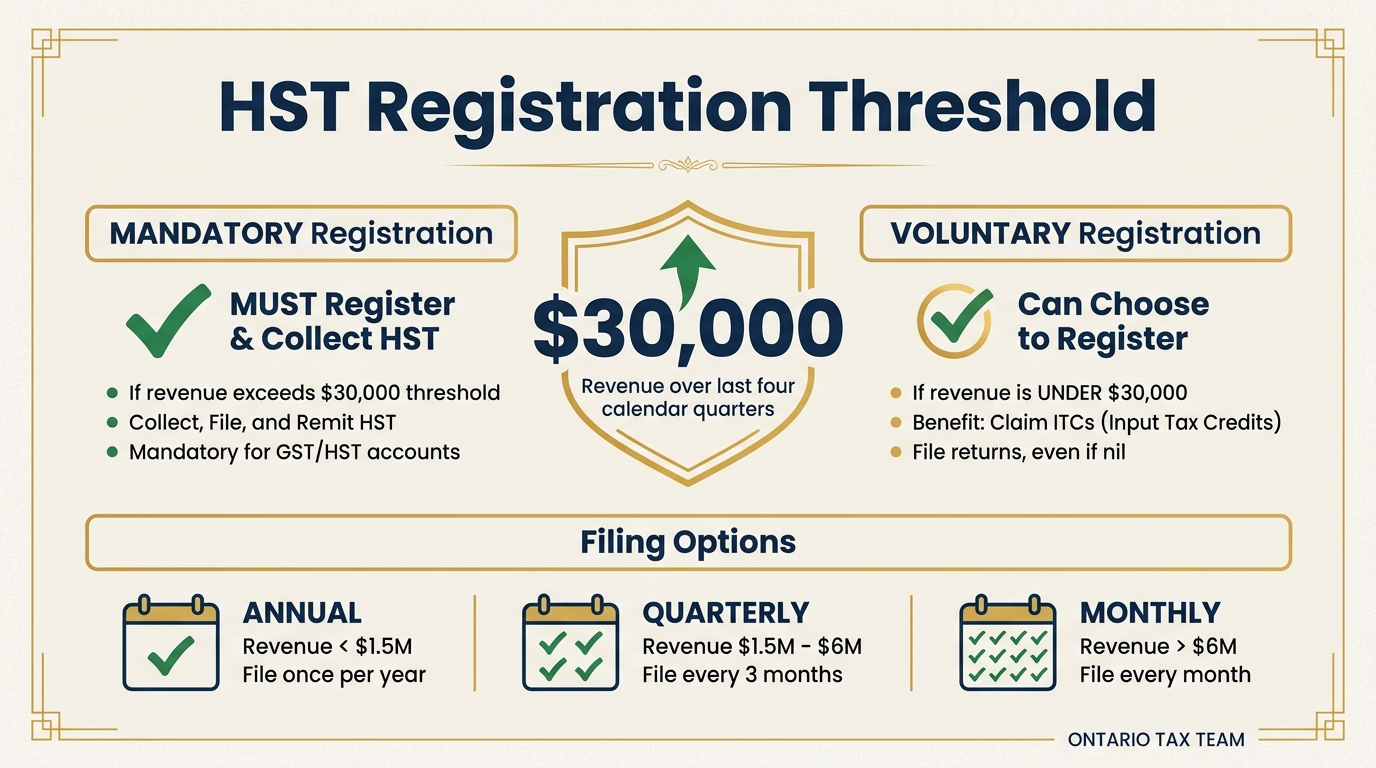
In Ontario, you must register for HST once your total taxable revenue exceeds $30,000 in any single calendar quarter or over four consecutive calendar quarters. Once you cross this threshold, you have 29 days to register.
However, you can also register voluntarily before reaching $30,000. Why would you? Because registering lets you claim Input Tax Credits (ITCs) on the HST you pay on business expenses. If you're buying equipment, paying for software subscriptions, or incurring significant startup costs, the ITCs can put money back in your pocket.
Registration is done through the CRA's Business Registration Online portal. You'll choose your reporting period (annual, quarterly, or monthly) and your filing method (regular or Quick Method). For a detailed walkthrough, see our guide on how to register for HST in Ontario. Our HST filing servicehandles the ongoing compliance once you're registered.
Step 4: Set Up a Payroll Account (When Hiring)
If you plan to hire employees - even one part-time worker - you need a payroll account with the CRA. This is separate from your HST registration and gets its own suffix on your BN. You can register for payroll at the same time you register your BN, or add it later when you make your first hire.
As an employer, you're responsible for:
- Withholding income tax, CPP contributions, and EI premiums from each employee's pay
- Matching the employee's CPP contribution (employer pays an equal amount) and paying 1.4 times the employee's EI premium
- Remitting these amounts to the CRA by the 15th of the following month (for most small employers)
- Filing T4 slips and a T4 Summary by the last day of February each year
- Issuing Records of Employment (ROEs) when employees leave
Getting payroll wrong is one of the most expensive mistakes a new business can make. The CRA charges penalties for late remittances starting at 3% and climbing to 10% for repeat offenders, plus daily compounding interest. If you're new to payroll, our payroll service handles the calculations, remittances, and year-end filings so you can focus on running your business.
Step 5: Open a Business Bank Account
If you've incorporated, a separate business bank account is mandatory - the corporation is a separate legal entity and its money is not your money. Even for sole proprietors, a dedicated business account is strongly recommended. Mixing personal and business transactions makes bookkeeping a nightmare, makes it harder to claim deductions, and raises red flags if the CRA ever reviews your file.
Most Canadian banks offer small business accounts with varying fee structures. Look for one that integrates with your accounting software (QuickBooks and Xero both connect to major Canadian banks for automatic transaction imports). Keep the account clean: business income goes in, business expenses go out, and personal transfers are clearly documented.
Step 6: Get Business Insurance
Insurance requirements vary by industry, but most businesses should consider at minimum:
- General liability insurance: Covers third-party bodily injury and property damage claims
- Professional liability (errors and omissions): Essential for consultants, accountants, IT professionals, and anyone providing advice or services
- Commercial property insurance: If you have a physical location, equipment, or inventory
- Workplace Safety and Insurance Board (WSIB): Mandatory in Ontario for most industries with employees
Some clients and contracts will require proof of insurance before they'll work with you. Getting coverage early avoids delays when opportunities come up.
Step 7: Set Up Your Bookkeeping System
Don't wait until tax time to think about bookkeeping. Choose your accounting software now, connect your bank account, and set up your chart of accounts. The two most common platforms for Canadian small businesses are QuickBooks Online and Xero, and either will serve you well.
At minimum, your bookkeeping system should track income by source, expenses by category, HST collected and paid, accounts receivable and payable, and bank reconciliations. If this feels overwhelming, our bookkeeping service can set up your file and manage it on an ongoing basis, or train you to handle the basics yourself.
Step 8: Understand Your Filing Obligations
New business owners are often caught off guard by how many filings the CRA expects. Here's a summary:
- Sole proprietors: Report business income on your T1 personal return (due April 30, or June 15 if self-employed, with any balance owing due April 30)
- Corporations: File a T2 corporate tax return within six months of your fiscal year-end; taxes owing are due two to three months after year-end
- HST: File HST returns according to your reporting period (monthly, quarterly, or annually)
- Payroll: Remit source deductions monthly (or quarterly for small employers); file T4s by end of February
- Ontario Annual Return: Corporations must file an annual return with the Ontario Business Registry
Step 9: Know Your Key First-Year Deadlines
Your first year sets the pattern. Mark these on your calendar:
- Within 29 days of exceeding $30,000 in revenue: Register for HST
- Before first payroll run: Register for a payroll account
- By the 15th of each month: Remit payroll source deductions (if applicable)
- Quarterly or annually: File HST returns (depending on your reporting period)
- Within 60 days of incorporation: Set up your corporate minute book, issue shares, and hold the first directors' meeting
- Six months after fiscal year-end: File your first T2 return
If the administrative side of running a business feels daunting, you're not alone. Many of our startup clients come to us specifically because they want to focus on their product or service, not paperwork. Getting professional help in year one builds good habits and prevents the kind of backlog that costs significantly more to untangle later.
Key Takeaways
- •Choose your business structure before registering anything - it determines your tax obligations, liability, and filing requirements
- •HST registration is mandatory once you exceed $30,000 in revenue, but voluntary registration lets you claim Input Tax Credits on startup costs
- •Payroll errors trigger some of the CRA's harshest penalties - get professional help if you're hiring employees
- •A separate business bank account is mandatory for corporations and strongly recommended for sole proprietors
- •Set up your bookkeeping system from day one - catching up later always costs more than doing it right from the start
Starting a New Business?
Our team handles CRA registration, HST setup, payroll configuration, and bookkeeping so you can focus on growing your business. Book a free 15-minute consultation.