Every small business owner starts out doing their own books. It makes sense in the beginning - revenue is low, transactions are few, and paying someone else to track a handful of invoices feels extravagant. But at some point, and it comes sooner than most people expect, the DIY approach starts costing you more than it saves. Here's why a bookkeeper isn't a luxury. It's one of the first hires that actually pays for itself.
The Hidden Cost of DIY Bookkeeping
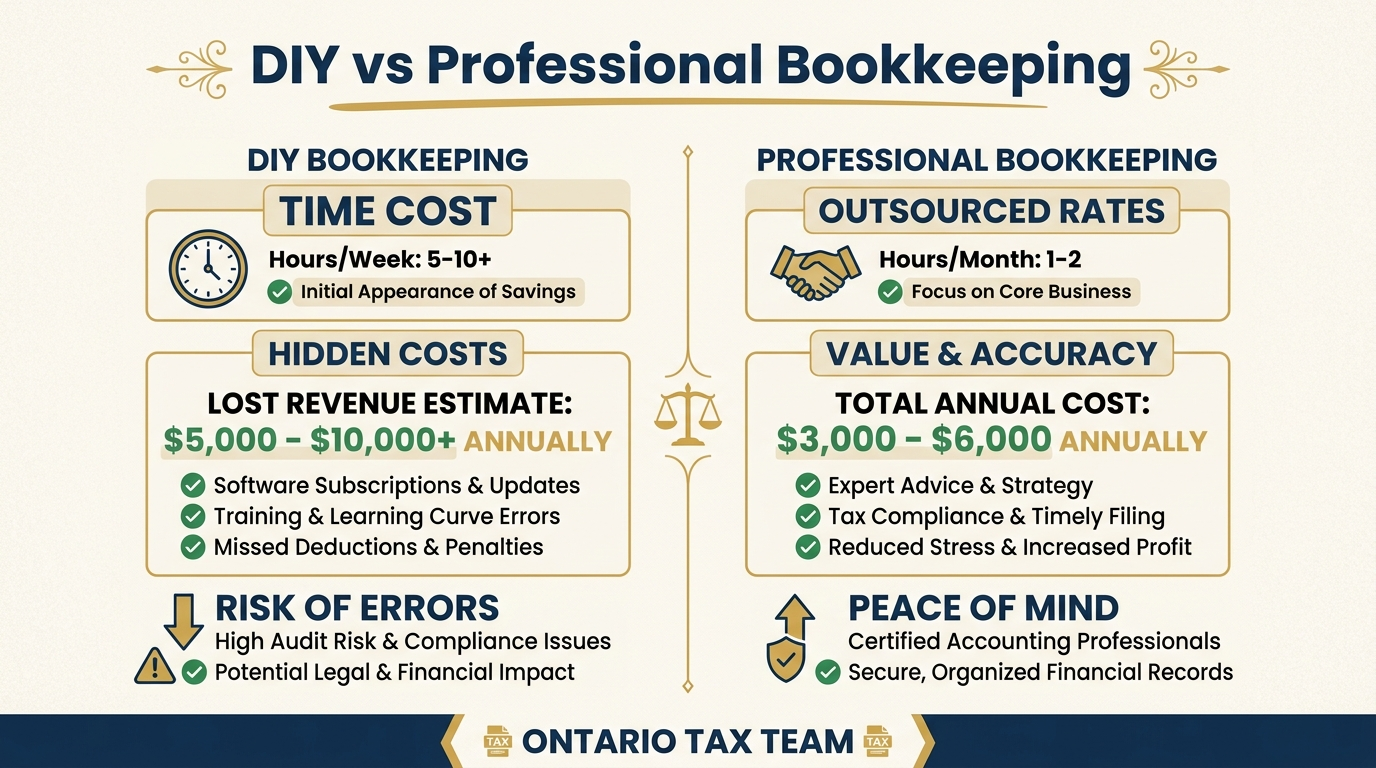
When you do your own bookkeeping, the sticker price is zero. But the real cost is your time - and the mistakes you make along the way. Consider what actually goes into maintaining your books:
- Categorizing and reconciling every bank and credit card transaction
- Issuing invoices and following up on unpaid ones
- Recording expenses and matching them to receipts
- Calculating and remitting HST
- Running payroll (if you have employees)
- Preparing reports for your accountant at tax time
- Fixing errors discovered months later
Most small business owners spend 5 to 10 hours per month on bookkeeping tasks - or more, if they've let things pile up. If your time is worth $100 per hour (a conservative estimate for most business owners), that's $500 to $1,000 per month in opportunity cost. You could be spending that time selling, serving clients, or simply not working. A professional bookkeeper typically handles the same work in a fraction of the time because it's what they do all day, every day.
What a Bookkeeper Actually Does
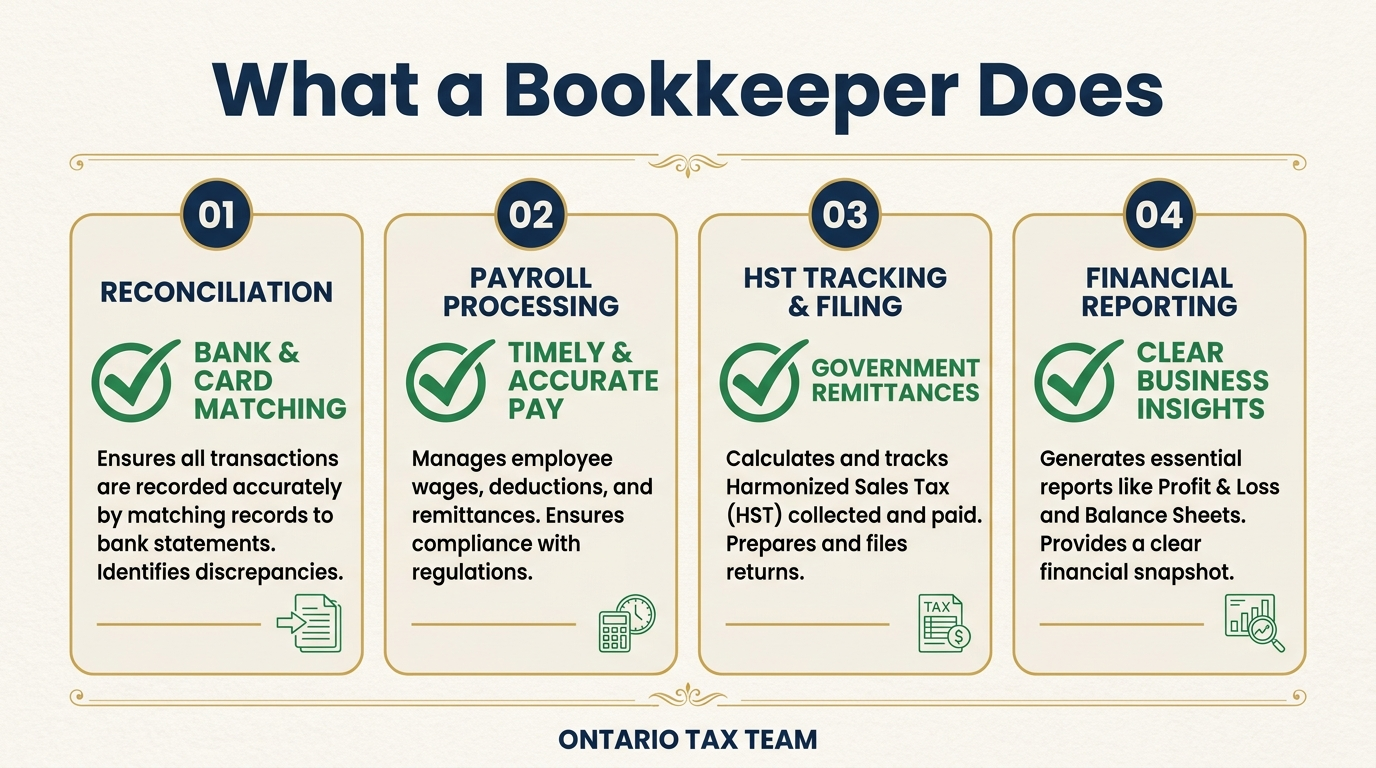
There's a common misconception that bookkeepers just “enter data.” A good bookkeeper does far more than that:
- Bank and credit card reconciliation: Matching every transaction in your accounting software to your bank statements, catching duplicates, and flagging anything unusual
- Accounts receivable management: Tracking who owes you money, sending reminders, and reporting on aging balances
- Accounts payable: Recording bills, ensuring timely payment to vendors, and tracking what you owe
- HST tracking: Calculating HST collected and paid, preparing the data for your HST return, and ensuring you're claiming all eligible Input Tax Credits
- Payroll processing: Running payroll, calculating deductions, remitting source deductions to the CRA, and preparing year-end T4s
- Monthly financial reports: Producing an income statement and balance sheet so you can see where your business actually stands
- Year-end preparation: Organizing your books so your accountant can prepare your tax return efficiently, which reduces your accounting fees
When you try to do all of this yourself, something inevitably falls behind. Usually it's reconciliation, which means you're making decisions based on numbers that may not be accurate.
Tax Savings from Accurate Books
Sloppy books don't just create headaches - they cost you money. When your records are disorganized or incomplete, legitimate deductions get missed. That equipment purchase you forgot to record? The vehicle expenses you didn't track? The home office deductionyou didn't claim because you weren't sure you qualified? Those are real dollars left on the table.
A bookkeeper ensures every deductible expense is properly recorded and categorized throughout the year, not scrambled together in a shoebox at tax time. For most small businesses, the deductions recovered through proper bookkeeping exceed the cost of the bookkeeper. It's not uncommon for clients to save $2,000 to $5,000 or more per year in tax simply by having complete and accurate records. For a deeper look at what you might be missing, read about how much a bookkeeper costs and the return on that investment.
CRA Compliance and Audit Readiness
The CRA requires you to keep organized records that support the income and deductions on your tax return. If you're selected for a review or audit, you'll need to produce bank statements, receipts, invoices, contracts, and a clear paper trail showing how the numbers on your return tie back to reality.
Businesses with messy books are more likely to trigger CRA scrutiny in the first place. Inconsistencies between reported income and bank deposits, round-number expenses, and large swings in profitability year over year are all red flags. A bookkeeper keeps your records clean and audit-ready year-round, which means less stress if the CRA ever comes knocking. Our bookkeeping service maintains your files to CRA standards from day one.
Cash Flow Visibility
You can't manage what you can't see. Without up-to-date books, most business owners are guessing at their cash position. They check their bank balance and assume that's the answer, ignoring outstanding invoices, upcoming bills, HST owing, payroll obligations, and income tax instalments.
A bookkeeper gives you a clear, current picture of your actual financial position - not just what's in the bank, but what's owed to you, what you owe others, and what's coming due. This visibility lets you make confident decisions about hiring, purchasing, pricing, and when to chase overdue accounts. Businesses that understand their cash flow survive. Businesses that don't are constantly surprised by shortfalls.
Better Business Decisions
Monthly financial statementsaren't just for your accountant. An accurate income statement tells you which products or services are profitable and which are dragging you down. A balance sheet shows whether your business is building equity or slowly bleeding it. Accounts receivable aging tells you which clients are paying late and how much cash is tied up in unpaid invoices.
These reports turn gut feelings into data. Should you raise your prices? The numbers will tell you. Is it time to hire? Your financial trends will reveal whether you can afford it. Should you take on that big project? Your cash flow forecast will show whether you can fund it without running short. A bookkeeper produces these reports regularly, and understanding them is the difference between reacting to problems and preventing them.
Signs You Need to Hire a Bookkeeper
If any of these sound familiar, it's time to get help:
- You're more than two months behind on bank reconciliation
- You dread opening your accounting software
- Your accountant has told you the books need significant cleanup before they can file your return
- You're not sure how much your business actually made last month
- You've missed an HST filing deadline or payroll remittance
- You're spending Sunday evenings on data entry instead of resting
- You received a CRA notice about a discrepancy and weren't sure how to respond
None of these individually are disasters, but collectively they signal that the DIY approach has outlived its usefulness.
In-House vs. Outsourced Bookkeeping
You have two main options: hire a part-time or full-time employee, or outsource to an accounting firm.
In-house bookkeeper:Best for businesses with high transaction volumes (retail, restaurants, construction) where someone needs to be on-site or available daily. Expect to pay $40,000 to $55,000 per year in salary plus benefits, payroll taxes, and management overhead. You'll also need to provide training, software access, and cover for vacations and sick days.
Outsourced bookkeeping: Best for small to mid-sized businesses that need regular but not daily attention. An outsourced bookkeeping firm typically charges $300 to $1,500 per month depending on volume and complexity. You get a trained professional (often a team) without the overhead of an employee. Our virtual bookkeeping service works with clients across Ontario through cloud-based platforms, making location irrelevant.
For businesses under $1 million in annual revenue, outsourcing almost always makes more financial sense. You get professional-quality work at a fraction of the cost of an employee, with built-in quality controls and backup coverage. To understand the full difference between these roles, read our guide on bookkeeping vs accounting.
The Bottom Line
A bookkeeper doesn't just organize your receipts. They protect your tax deductions, keep you compliant with the CRA, give you visibility into your cash flow, and free up your time for the work that actually grows your business. The cost of a bookkeeper is almost always less than the cost of not having one - in missed deductions, wasted time, penalties, and poor decisions made without reliable data. If you're ready to stop guessing and start knowing where your business stands, our small business services are a good place to start.
Key Takeaways
- •DIY bookkeeping costs most business owners 5 to 10 hours per month in time that could be spent on revenue-generating work
- •Accurate books typically recover $2,000 to $5,000+ per year in tax deductions that would otherwise be missed
- •A bookkeeper keeps you CRA-compliant and audit-ready year-round, not just at tax time
- •For businesses under $1 million in revenue, outsourced bookkeeping is almost always more cost-effective than hiring in-house
- •If you're more than two months behind on reconciliation or dreading your accounting software, it's time to get professional help
Ready to Hire a Bookkeeper?
Our bookkeeping team provides professional, affordable bookkeeping for small businesses across Ontario. Book a free 15-minute consultation.